


👋🏼 Hello friends! Let’s enjoy another Sunday Drive around the Internet.
🎶 Vibin’
The week past was quite a wild one, but now it’s time to turn our eyes to Thanksgiving and the “official” start of the Holiday Season, and hopefully to the peace that it might bring.
So this week, I’m vibin’ to Bing Crosby and Rosemary Clooney’s gentle rendition of Count Your Blessings from the movie, White Christmas. Enjoy.
💭 Quote of the Week
“This is the worst market decline since the last one you don’t remember or care about anymore.” — Morgan Housel
📈 Chart of the Week
😱 Are We Afraid Enough Yet?
Wall Street’s fear gauge finally woke up this week. After six straight down days for the S&P 500, the VIX spiked as high as 40 on Friday (per Bloomberg), its highest level since the April 2025 tariff panic.
Quick refresher. The VIX measures the implied volatility of S&P 500 options over the next 30 days. Think of it as the price of portfolio insurance. When investors scramble for protection, the VIX jumps.
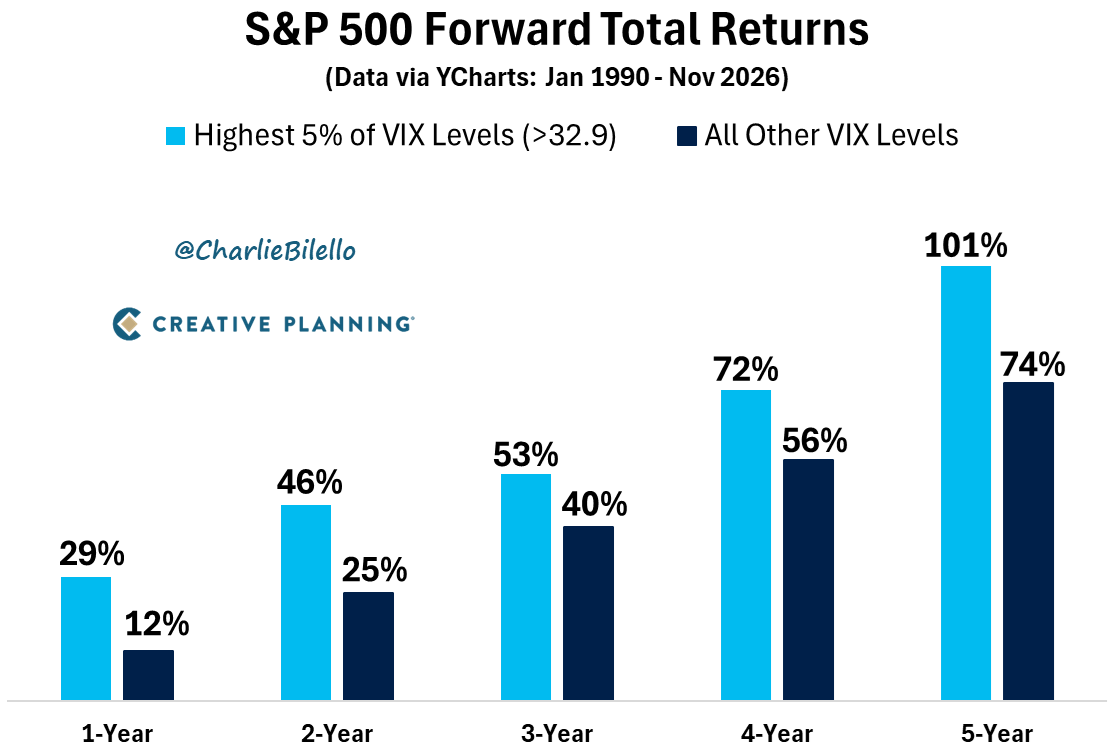
This week’s chart encapsulates every trading day since 1990, sorted by the level of the VIX. The top 5% of readings, anything above 32.9, are the scariest days of the last 36 years. It also shows what happened next.
The answer appears to be very interesting. Buy the S&P 500 on one of those days and your forward total return beat the “normal” days at every horizon: 29% vs. 12% over 1 year, and 101% vs. 74% over 5 years. Annualized, that 5-year gap works out to roughly 15.0% vs. 11.7% a year.
That’s Warren Buffett’s rule, in numbers. In his 1986 shareholder letter he wrote that Berkshire attempts “to be fearful when others are greedy and to be greedy only when others are fearful.” Friday pretty much put us squarely in the fearful bucket.
So, back up the truck and buy stocks with both hands? Not so fast. There are a few things a bar chart can’t show you.
The sample is smaller than it looks. High-VIX days come in clusters: 1998, 2001-02, 2008-09, 2011, 2020, 2025, and a few others. Thousands of overlapping return windows boil down to roughly a dozen independent episodes. And every one of them happened in a US market that eventually recovered.
Early is painful. Buffett published “Buy American. I Am.” in the New York Times in October 2008, with the S&P 500 near 946. It bottomed at 677 the following March, almost 30% lower. Five years later he looked like a genius. Five months later he looked like a guy who’d caught a falling knife. Most investors can’t sit through that second part.
The VIX can go a lot higher. 18 years ago, on November 20, 2008, it closed at a record 80.86. Friday’s reading is elevated, but it’s a long way from that. To be honest, I view that time as a true thousand year flood when the wheels were literally coming off the global financial system. I don’t believe we are anywhere near that type of scenario today. That said, I still thought it was worth pointing out.
So what might a VIX in the upper 30s portend? If history rhymes, better-than-average returns over the next 1 to 5 years, with some ugly detours along the way. I’d call that a decent setup for patient money and a dangerous one for money that needs to be spent in the next year or two.
The practical lesson cuts both ways. Fear raises prospective returns, and it also raises the price of protection. Put options cost the most right when you want them most. The time to buy an umbrella is before it rains; the time to put cash to work is when it’s pouring.
Are we afraid enough yet? Maybe. If not, we might be getting close.
Sources: S&P 500 Forward Total Returns by VIX Level, Charlie Bilello (Creative Planning), Berkshire Hathaway 1986 Chairman’s Letter, Buy American. I Am., Warren Buffett (New York Times, 10/16/2008), VIX jumps 26.20% to 35.89 as tech selloff intensifies (ad-hoc-news, citing Bloomberg), CBOE Volatility Index: VIX (FRED)
🚙 Interesting Drive-By’s 🚙
📉 Financial Stability Report (November 2026) - The Fed’s twice-yearly risk checkup puts hedge fund leverage at the highest level since its data began in 2013, private credit vehicles at more than $2.6 trillion, and big tech’s data center leases not yet on the books at more than $1 trillion (undiscounted), which helps explain why AI was the risk its market contacts cited most: the risks we don’t see are increasingly the ones parked off balance sheet.
💰 AI Tracker (November 2026) - Michael Cembalest’s chart deck tallies $2.4 trillion of hyperscaler capex and R&D since 2022 and puts major AI obligations at $0.8 trillion on balance sheet versus $4.8 trillion off it, the clearest map I’ve seen of how much of the AI buildout is financed where most investors aren’t looking.
🤔 What Happens When We Try to Know Everything? - Kyla Scanlon reads a week of outages (Microsoft, the FAA, Chase, Apple) as the bill coming due for cutting the people who carry hands-on knowledge, and argues the economy runs on a trust that’s already thin: only 9% of 18-to-34-year-olds told WSJ/NORC they have “a great deal” of confidence in major companies.
💡 Rethinking the Retirement Economy - With Social Security’s retirement trust fund projected to run dry in the fourth quarter of 2032, Upjohn Institute economist Brian Asquith shows how state and local tax breaks pay people to retire early and stay put in big houses, and argues relief should be targeted by income instead of age (a demographics-is-destiny piece plenty of readers won’t like, and should read anyway).
🧬 Gut Microbiome Activity Linked to Exceptional Longevity May Support Healthier Aging - Centenarians showed more activity from a bile-acid-processing gut enzyme than younger adults, and when UC San Diego researchers boosted it in old mice with engineered bacteria, insulin sensitivity improved and fat mass fell (mice only, with no lifespan gain shown, but it’s the kind of small, testable lever that turns longevity from hope into engineering).
📈 India Is Quietly Doing Great - Noah Smith points out China was 40% richer than India is today when its growth slowed to India’s current pace in 2014, so India’s 6.5% has a long runway, though the risks he flags (weak private investment, sluggish foreign direct investment, female underemployment) are what anyone rotating from China to India should watch.
👋🏼 Parting Thought
An attitude of gratitude: I’m thankful for my family, my friends and colleagues, and for each of you who spends a little of your Sunday with me. Happy Thanksgiving!
If you have any cool articles or ideas that might be interesting for future Sunday Drive-by’s, please send them along or tweet ‘em (X ‘em?) at me.
Please note that the content in The Sunday Drive is intended for informational purposes only, and is in no way intended to be financial, legal, tax, marital, or even cooking advice. Consult your own professionals as needed. The views expressed in The Sunday Drive are mine alone, and are not necessarily the views of Investment Research Partners.
I hope you have a relaxing weekend and a great week ahead. See you next Sunday...
Your faithful financial provocateur,
-Mike
If you enjoy the Sunday Drive, I’d be honored if you’d share it with others.
If this was forwarded to you, please subscribe and join the other geniuses who are reading this newsletter.