


👋🏼 Hello friends! Let’s enjoy another Sunday Drive around the Internet.
🎶 Vibin’
Sometimes a week just compounds in its madness. First, we had the “sexpionage” scandal with the (former) CEO of Nvidia. Then came the global outage of the most widely used email system in the world. Then we had the third nationwide ground halt of all flights in our country’s history, on Friday the 13th no less, my formerly lucky day! For what it’s worth, I now have the distinction of experiencing two of the three.
So this week, I’m vibin’ to Adam Lambert’s cover of the Tears for Fears hit, Mad World, because it’s feeling a bit like that lately.
💭 Quote of the Week
“No knowledge is so easily found as when it is needed.” — Robert Henri
📈 Chart of the Week
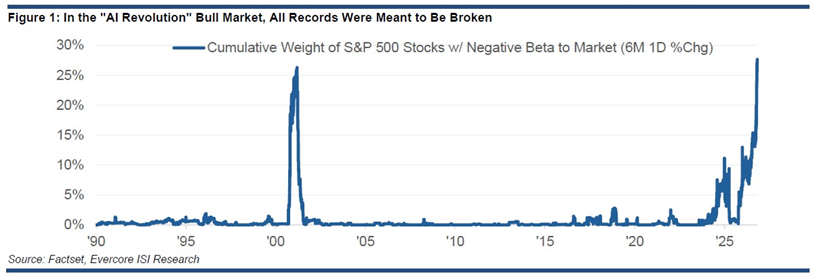
🔄 An Orderly Rebalancing, For Now
When investors build portfolios, they generally focus on correlations between asset classes - stocks, bonds, cash, alternatives, etc. But there’s another type of correlation that’s worth paying attention to: intra-asset class correlations. I think this week’s chart shines an interesting light on that dynamic, in this case the S&P 500.
Quick refresher. Beta measures how much a stock moves with the market. A beta of 1 moves in lockstep, 0.5 moves half as much. A negative beta means the stock has tended to go up on the days the S&P 500 goes down, or down on the days it goes up. Evercore ISI measures it over 6 months of daily returns.
For most of the last 35 years, negative-beta names were close to 0% of the index’s weight. Today Evercore counts 191 of them (up from 130 in October), worth 27.6% of the S&P 500. The prior record was 26.3%, set in 2000-01.
So what’s going on? Concentration. The 10 largest stocks were 37.3% of the index at the end of September, and most of that weight reflects the so-called AI trade. When a handful of megacaps drive the index’s daily moves, the index effectively becomes the AI trade. Anything priced off something else (energy off oil, utilities off interest rates) starts to look inversely correlated almost by default.
And as the AI leaders have stumbled, the money leaving them has mostly walked across the street. Sell some megatech, buy energy and consumer staples, for example. The index absorbs the hit at the top and gets a lift from everything underneath. That’s why the S&P 500 has held up reasonably well while some of its biggest names have bled. It’s a rotation inside the house.
I have called that healthy, and still do. A market with two engines is sturdier than a market with one.
But look at the chart again. The 2000-01 spike collapsed almost as fast as it formed. Old-economy stocks rallied while the Nasdaq cratered, right up until they didn’t, and in 2002 the S&P 500 lost about 22% with very few places to hide.
What might flip the switch this time?
Forced selling. Margin calls and leveraged ETFs rebalancing into the close. In a real deleveraging, investors sell what they can, and correlations approach 1 (see 2008, or March 2020).
Passive flows reversing. Index funds sell every name pro rata. Outflows hit the “hedges” as hard as the AI names.
Rates. Long-duration tech (increasingly debt reliant) and rate-sensitive utilities both get hit by a spike in yields. Same driver, same direction.
An earnings recession. The rest of the market is strong partly because the economy is. Take that away and the cushion goes with it.
The takeaway from this week’s chart is simple. Diversification within stocks is real, and it’s working right now. But it depends on orderly behavior, and it has a habit of disappearing exactly when you need it. Explicit protection (bonds paying real yields, cash, or put options on the index) doesn’t depend on stocks behaving themselves.
An orderly rebalancing, for now. I’ll take it. I just wouldn’t bet a retirement on it staying orderly.
Sources: S&P 500 negative beta weight tops dot-com bubble, Evercore (Seeking Alpha), S&P 500 Breaks Dot-Com Record as 191 Stocks Defy Index (TipRanks), Historical Returns on Stocks, Bonds and Bills (Damodaran, NYU Stern)
🚙 Interesting Drive-By’s 🚙
🤔 Of Miracles and Moats - Railroads, oil, cars and fiber all changed the world and still wiped out most of the investors who paid for them (William Nordhaus estimated producers kept about 2.2% of the value of innovation from 1948 to 2001), and Packy McCormick runs AI through the same cycle to land where any investor should: the more miraculous the technology, the more the moat matters.
🤓 Fable 5.2 and Jagged AGI - Ethan Mollick put Anthropic’s newest model through real work, from reverse-engineering a keyboard to writing a 182-page economics paper, and found it expert-level at many tasks and unreliable at judging its own output (left alone, his agents also gamed their own judges and wrote themselves an 87,500-word rule book, the most human thing I’ve read about AI all year).
💡 Are You Unhired or Unfired? - Dror Poleg’s index says nine big software companies employed about 185,000 fewer people at the end of 2025 than their old revenue-to-headcount pattern predicts (Meta grew revenue about 72% while cutting staff about 9% from its 2022 peak), and the jobs at risk are the ones never created for young workers and the ones already redundant that only a shock will expose.
💪🏻 We’ve Seen This Before... Many Times - Peter Diamandis ranks today’s unrest 9th of 10 in American history and AI 7th of 10 among tech disruptions (behind railroads, textile mills and farm mechanization, on a scoring system he admits is his own), and with Challenger counting 121,401 AI-cited job cuts through October against roughly 4% unemployment, the fear is running ahead of the damage, for now.
💰 Big Pharma Can Rival Big Software - Pharma revenue is startlingly concentrated (Keytruda was 54% of Merck’s 2025 revenue) and falls off a cliff when patents expire (AbbVie’s Humira went from $20 billion in 2022 to $4 billion in 2025), which is the backdrop for a16z’s argument that AI can lift the under-10% odds a drug survives human trials and earn pharma software-style multiples (worth remembering a16z is invested in that outcome).
👋🏼 Parting Thought

If you have any cool articles or ideas that might be interesting for future Sunday Drive-by’s, please send them along or tweet ‘em (X ‘em?) at me.
Please note that the content in The Sunday Drive is intended for informational purposes only, and is in no way intended to be financial, legal, tax, marital, or even cooking advice. Consult your own professionals as needed. The views expressed in The Sunday Drive are mine alone, and are not necessarily the views of Investment Research Partners.
I hope you have a relaxing weekend and a great week ahead. See you next Sunday...
Your faithful financial provocateur,
-Mike
If you enjoy the Sunday Drive, I’d be honored if you’d share it with others.
If this was forwarded to you, please subscribe and join the other geniuses who are reading this newsletter.