


👋🏼 Hello friends! Let’s enjoy another Sunday Drive around the Internet.
🎶 Vibin’
This past week has certainly been a trying one in terms of the financial markets. But this week I’m vibin’ to something very different in terms of emotions and memories. Earlier this year, I lost my mother to (basically) old age, but that doesn’t make me miss her any less. I also recently lost a friend and mentor to cancer at an all too young age.
So, this week I’m vibin’ to a song written by Pat Monahan, frontman for the band Train, who wrote it in memory of his mother, also lost to cancer. I hope you enjoy Drops of Jupiter from 2001.
💭 Quote of the Week
"Learn the rules like a pro, so you can break them like an artist." — Pablo Picasso
📈 Chart of the Week
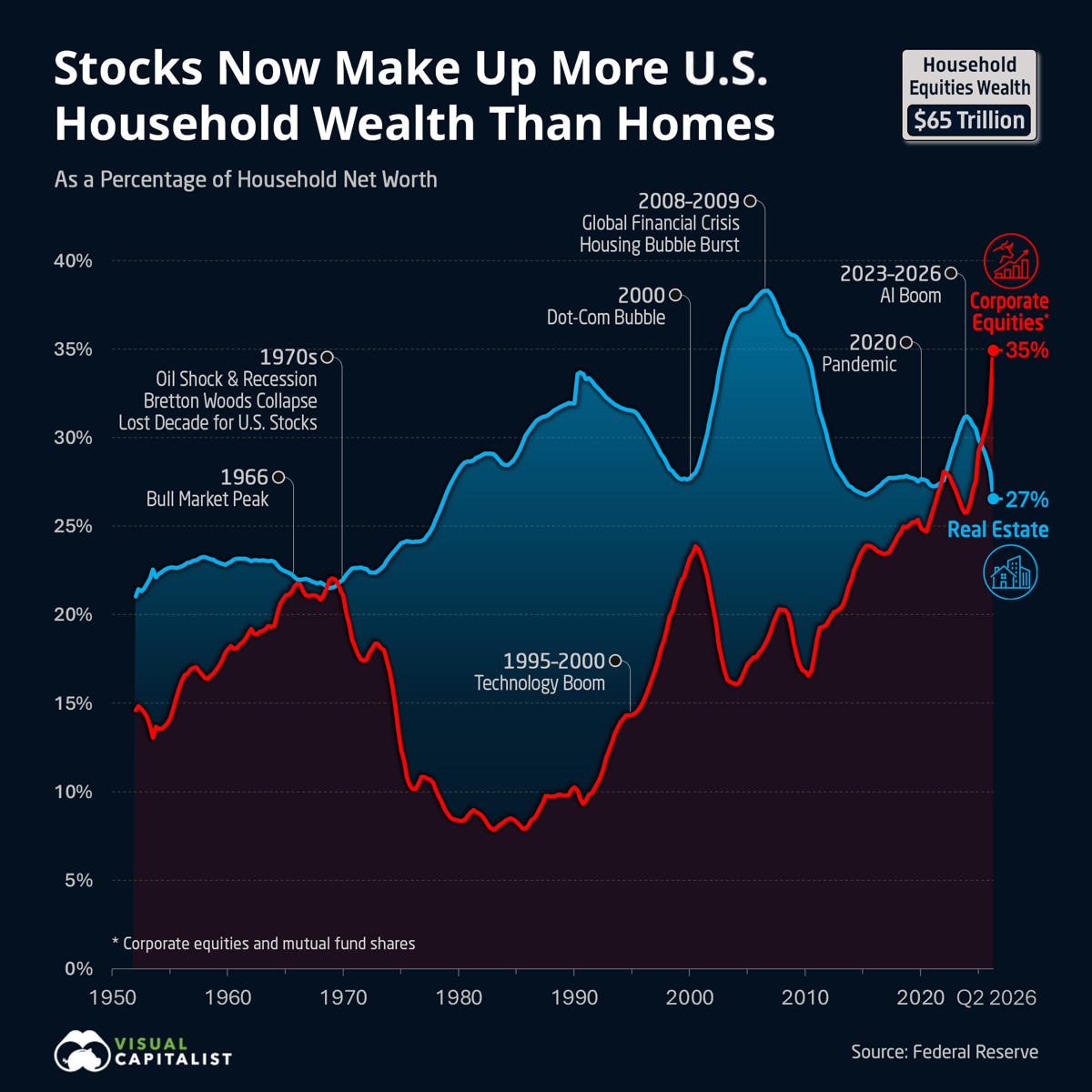
Taking Stock of U.S. Household Wealth
In 1983, stocks were sitting near 8% of household net worth, and the family home was where American wealth really lived.
Fast forward to Q2 2026. Stocks and mutual funds now make up 35% of household net worth and real estate just 27%, per the Fed. That’s the widest gap in favor of stocks since the data begins in 1952.
The obvious story is the bull market in equities. Household stock holdings rose from about $51 trillion to $65 trillion in the year through June, while household real estate rose 2.5%. That accounts for the last 12 months. For the longer climb from 8% to 35%, we need to look at plumbing and demographics.
Start with the plumbing. In the 1950s and ‘60s, retirement assets sat mostly in corporate pensions, and the Fed doesn’t count pension assets as household wealth. IRAs arrived in 1974 and the 401(k) in 1978. The Fed counts stocks and funds held outright (IRAs included) and keeps 401(k)s in a separate bucket. So every retiree who rolls a 401(k) into an IRA moves money onto this chart.
Then there are the demographics. In 2011, San Francisco Fed economists Zheng Liu and Mark Spiegel projected that boomer retirements would drag the market P/E from about 15 to about 8.3 by 2025, as retirees sold stocks to live on. P/Es spent 2025 in the 20s instead.
Boomers kept their stocks, and for two good reasons.
Longevity is the first. A retirement that might run 30 years needs growth assets like equities, so the old “100 minus your age” equity allocation rule got quietly retired.
Taxes are the second. A long-held winning position gets a step-up in basis at death, which makes selling it in your 70s the expensive choice. The rational move is to sit tight.
The houses are locked up too. Median homeowner tenure nearly doubled from 6.5 years in 2005 to 11.9 years in 2023, according to Redfin, with boomers aging in place and low-rate mortgages keeping everyone else put. Homes barely trade, so they barely reprice. Stocks reprice every day.
And “household” is a generous word here. The top 1% own 50.9% of household stocks; the bottom half owns 0.6%. Real estate is spread far more evenly.
We also need to account for risk. The 2 earlier times stocks caught real estate on this chart, the late 1960s and 2021, were followed by the 1970s lost decade and the 2022 bear market. Jesse Livermore’s 2013 essay on the average investor’s equity allocation found that high allocations have historically preceded weak 10-year returns. Counting 401(k)s and other indirect holdings, households held a record 48.2% of financial assets in stocks at the end of June.
So the biggest pile of equity risk in the country belongs to the investors with the least time to recover from a drawdown and the strongest tax reasons not to trim.
If that’s you, the question worth asking is how to lower the risk without handing the IRS a check first. 🤷🏼♂️
Sources: Visual Capitalist, “Stocks Now Make Up More U.S. Household Wealth Than Homes”; Federal Reserve, Financial Accounts of the United States (Z.1), Q2 2026, Recent Developments (Sept. 11, 2026); FRED, Households; Corporate Equities and Mutual Fund Shares (BOGZ1LM193064005Q); NAHB Eye on Housing, “Value of Household Real Estate Assets Approaches $50 Trillion” (Sept. 2026); FRED, Share of Corporate Equities and Mutual Fund Shares Held by the Top 1% (WFRBST01122); FRED, Share Held by the Bottom 50% (WFRBSB50203); Liu and Spiegel, “Boomer Retirement: Headwinds for U.S. Equity Markets?” FRBSF Economic Letter 2011-26 (Aug. 22, 2011); ResiClub, Redfin analysis of median homeowner tenure (Feb. 21, 2024); Jesse Livermore, Philosophical Economics, “The Single Greatest Predictor of Future Stock Market Returns” (Dec. 2013); Opening Bell Daily, “US household stock allocation hits a record 48%” (Oct. 23, 2026).
🚙 Interesting Drive-By’s 🚙
🤔 The AI Business Model Just Collapsed - The headline oversells it and Ted Gioia is mostly scoring his own past calls, but his tally is hard to ignore: Oracle down from $265 to $114 and CoreWeave from $138 to $42 since his warnings, and 40 of 41 data center measures on Tuesday’s ballots going against AI.
📉 Q3 GDP: Why We Expect A Downward Revision - The BEA’s first read on third-quarter growth was a strong 3.4%, but Jake Schneider expects revisions to knock it down to about 2.4% as weaker consumer spending and trade show up (the trade deficit widened from $71 billion to $106 billion between June and August), leaving AI investment carrying the economy, which is the leg everyone else is worried about.
📉 Just how important is the AI and data center backlash? - After an election where 56% of voters called AI and data centers a major factor and about forty localities passed restrictions, James Pethokoukis still expects the build-out to continue, but the number investors should notice is Cleanview’s: 41% of America’s planned data center pipeline now sits in states whose new governor backs a pause ($paywall).
🤔 The Great Diffusion - In 1900 fewer than 15% of American homes had indoor plumbing and a forecaster would have put the market for washing machines at zero, which is Arnold Kling’s case that the tidy math behind conservative AI forecasts (under 1% a year in productivity) misses the industries that don’t exist yet, with the catch that real diffusion takes decades.
🤔 Survival Is Becoming a Subscription Service - When AI found serious holes in PHP this month, sites on WordPress.com’s managed service were already protected when the fixes shipped while self-hosted owners were told to update immediately, and Dror Poleg’s warning is that this is how security, health and much else will work from now on: a steady flow of new threats you pay a subscription to defend against (and a real risk for anyone who stops paying or stops watching).
👋🏼 Parting Thought

If you have any cool articles or ideas that might be interesting for future Sunday Drive-by’s, please send them along or tweet ‘em (X ‘em?) at me.
Please note that the content in The Sunday Drive is intended for informational purposes only, and is in no way intended to be financial, legal, tax, marital, or even cooking advice. Consult your own professionals as needed. The views expressed in The Sunday Drive are mine alone, and are not necessarily the views of Investment Research Partners.
I hope you have a relaxing weekend and a great week ahead. See you next Sunday...
Your faithful financial provocateur,
-Mike
If you enjoy the Sunday Drive, I’d be honored if you’d share it with others.
If this was forwarded to you, please subscribe and join the other geniuses who are reading this newsletter.