


👋🏼 Hello friends! Let’s enjoy another Sunday Drive around the Internet.
🎶 Vibin’
I guess there could be a loose connection this week with what I’m vibin’ to and the recent…umm… adjustment in expectations for the pace and profitability of the AI buildout.
But really, I’m just enjoying a creative cover (you know me, right?) by one of my favorite singers, Morgan James, who I believe deserves to be much more widely known than she is.
Let’s enjoy Scott Bradlee’s Postmodern Jukebox and Morgan James covering Aerosmith’s classic hit, Dream On.
💭 Quote of the Week
"You do not merely want to be considered just the best of the best. You want to be considered the only ones who do what you do." — Jerry Garcia
📈 Chart of the Week
If This is Peak AI, Where to Now?
Anyone who learned to drive a stick shift knows the feeling. You ease off the gas, the car keeps rolling, and your head tips forward just a bit. You’re still moving. The push is gone.
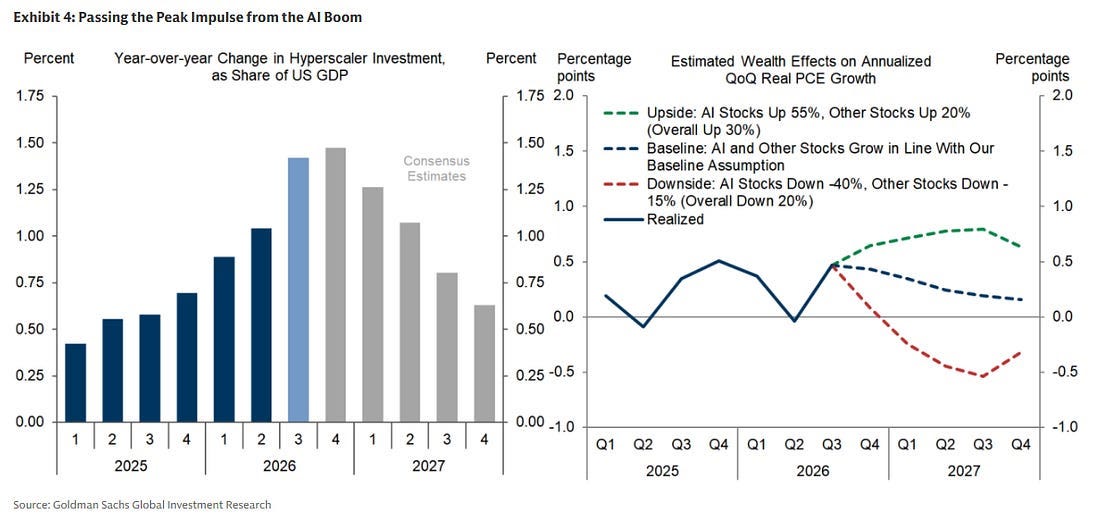
Goldman Sachs seems to think the AI boom is about to hit that moment. The left side of this week’s chart tracks the year-over-year increase in hyperscaler investment as a share of US GDP. It peaks near 1.5% this quarter, then slides to roughly 0.6% by late 2027 on consensus estimates. The spending keeps growing. It just grows by less each quarter, and GDP growth runs on the change, so the push fades.
The graph on the right side is the part I find more interesting, because it’s about consumer spending.
When stocks go up, the people who own them spend more. Economists call it the wealth effect. Goldman estimates it added 0.4 percentage points to US consumer spending growth over the past year.
Look at the solid line first. It’s jumpy. It slipped below zero in Q2 2025 (hello, tariff selloff) and dipped to about zero again in Q2 2026. When the market wobbles, the boost disappears within a quarter.
Now the dotted lines:
Baseline: stocks do roughly what Goldman expects, and the boost still fades, from about 0.5 points today to around 0.15 by the end of 2027.
Upside: AI stocks up 55%, everything else up 20%. The boost climbs to about 0.8 points.
Downside: AI stocks down 40%, everything else down 15%. Spending growth takes a hit of roughly half a point by Q3 2027.
That’s a gap of more than a full point between the best and worst case. Consumer spending is about two-thirds of GDP, so that’s a big spread between scenarios.
And the channel is narrow. The top 10% of earners did 49.2% of all US consumer spending in Q2 2025, according to Moody’s. They also own most of the stocks. So a big chunk of the economy is leaning on a small group and their portfolios which, like it or not, lean hard on AI.
The baseline is the friendly case, and even there the tailwind shrinks by about two-thirds. The downside doesn’t require anything exotic, either. The Nasdaq lost a third of its value in 2022.
Meanwhile, Apollo’s Torsten Slok says AI has delivered “zero financial payoff to corporate America outside of tech.” The productivity gains that are supposed to pick up where the capex push leaves off haven’t shown up in the numbers yet.
My guess is that we land somewhere between baseline and downside: a slower consumer in 2027, with GDP growth more exposed to AI stock prices than most forecasts admit. To be fair, Goldman’s base case is that AI pays off eventually. I hope they’re right.
For anyone near or in retirement, this one’s personal. If your spending plan assumes the market keeps doing what it’s done for the past 3 years, you’re making the same bet the economy is.
Coasting is fine, as long as nobody hits a pothole.
Sources: Goldman Sachs Global Investment Research, Exhibit 4, “Passing the Peak Impulse from the AI Boom” (via Fortune); Fortune, “AI’s boost to the U.S. economy is nearing its peak, Goldman says, as Apollo finds ‘zero financial payoff’ outside Big Tech” (Oct. 26, 2026); BigGo Finance, “Goldman Sachs: AI Infrastructure Investment Growth to Peak in Q4” (Oct. 27, 2026); Bloomberg, “Top 10% of Earners Drive a Growing Share of US Consumer Spending” (Sept. 16, 2025).
🚙 Interesting Drive-By’s 🚙
💡 The best time ever to be 5 years old - Alpha School says its students learn 2.6 times faster, but Stephen McBride’s useful finding is that the same AI software used at home barely moved the needle until the school added cash incentives and one human guide per five kids, which says the scarce ingredient in an AI world is motivation, not information (the gains are self-reported and tuition runs $40,000 to $75,000, so call it a promising pilot).
📉 The AI Selloff Is a Debt Story - When Peter Diamandis, of all people, warns that CoreWeave’s bonds yield around 15% on more than $50 billion of obligations and compares the neoclouds to the 2000 fiber bust (only 2.7% of that fiber was in use by 2002), it’s worth listening to his punchline: the technology will be fine, but “it was the second owners, not the first, who made the money.”
🏠 The Price of Leaving - Sol Goldman’s heirs built a buyout clause so any branch could cash out at an appraised price, and when two of them did, they say the appraisal came in at least $570 million too low, which is now headed to trial and is the best argument I’ve seen for deciding who picks the appraiser before anyone wants out.
💡 Slop Is the New Oil - Quibi spent up to $125,000 a minute on premium video and was dead within the year while TikTok won with a flood of cheap attempts, and Dror Poleg’s point is that AI turns that power law into the whole economy’s operating system, where most bets fail and “finding something that works buys time, not a permanent solution” (a good argument for owning the field instead of betting on the one sure thing).
💡 Farewell, my Captain - Noah Smith’s tribute to Patrick Stewart, who died this week at 86, argues Captain Picard showed what a reasonable, optimistic humanity could look like, and adds a twist worth chewing on: in an AI world the machines will probably do the exploring, so the frontier left for us is becoming better people.
👋🏼 Parting Thought
Who knows what November may bring? 🤷🏼♂️

If you have any cool articles or ideas that might be interesting for future Sunday Drive-by’s, please send them along or tweet ‘em (X ‘em?) at me.
Please note that the content in The Sunday Drive is intended for informational purposes only, and is in no way intended to be financial, legal, tax, marital, or even cooking advice. Consult your own professionals as needed. The views expressed in The Sunday Drive are mine alone, and are not necessarily the views of Investment Research Partners.
I hope you have a relaxing weekend and a great week ahead. See you next Sunday...
Your faithful financial provocateur,
-Mike
If you enjoy the Sunday Drive, I’d be honored if you’d share it with others.
If this was forwarded to you, please subscribe and join the other geniuses who are reading this newsletter.