


👋🏼 Hello friends! Let’s enjoy another Sunday Drive around the Internet.
🎶 Vibin’
As many of you know, I’m always on the lookout for canaries in the coal mine. Most often, they’re false canaries, but still worth pointing out anyway.
So, in keeping with the topic discussed in the Charticle™ below, this week I’m vibin’ to Cream’s 1967 hit, Strange Brew. Far out, man.
💭 Quote of the Week
“The cost of debt is not the interest rate you pay. It’s the independence you forfeit.”
— Morgan Housel
📈 Chart of the Week
Is Something Strange Brewing in Credit?
In the movie Ghostbusters, the first sign of trouble is subtle: a stack of library cards floating in the air at the New York Public Library. Library cards don’t scare anyone. The Stay Puft Marshmallow Man shows up later.
The credit market may be floating some library cards right now.
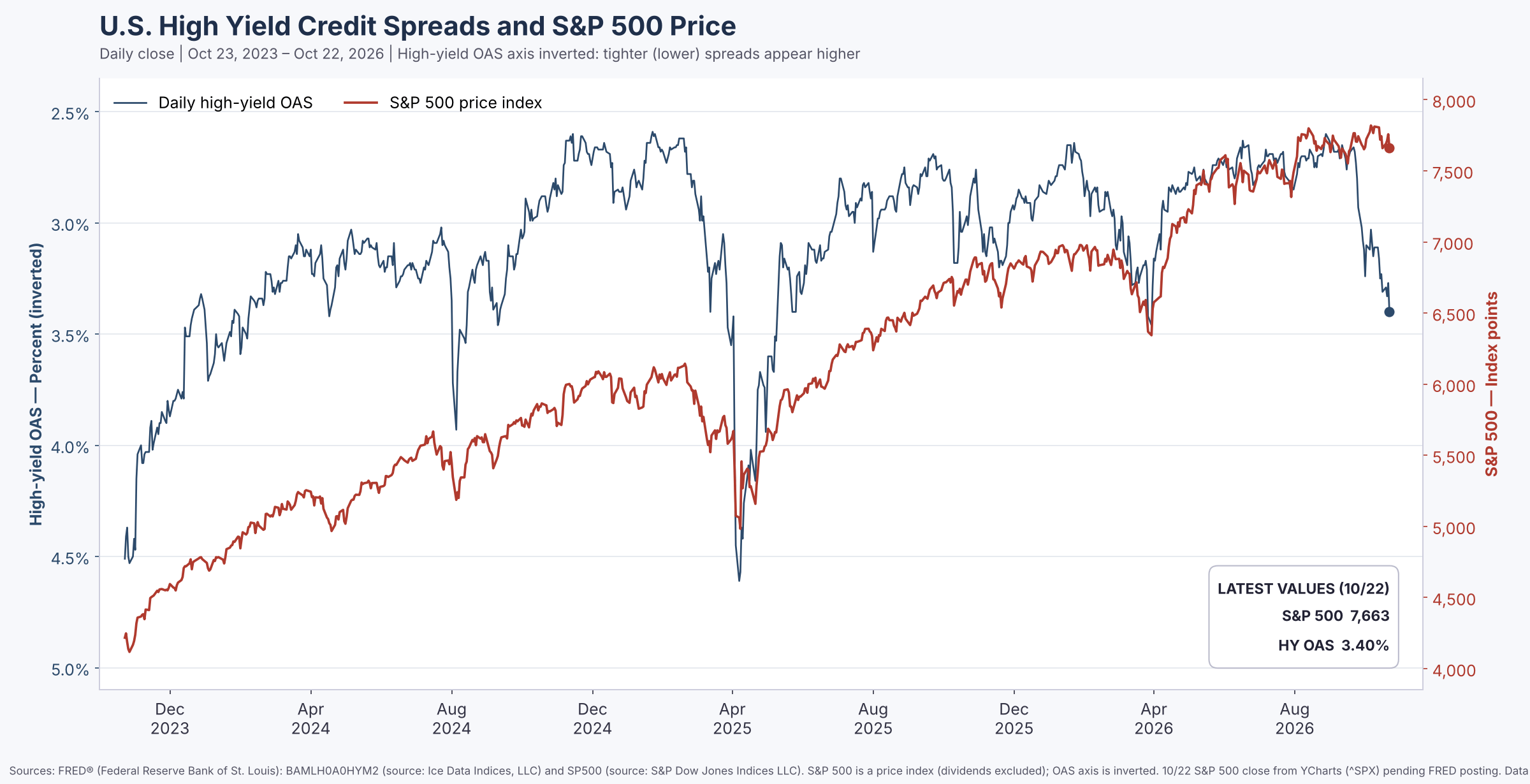
This week’s chart shows the high-yield option-adjusted spread (OAS), the extra yield investors demand to own junk bonds over Treasuries, against the S&P 500. The spread axis is inverted (flipped), so when the blue line falls, bonds are too.
For most of the past 3 years, the 2 lines have moved together. Look at August 2024, April 2025 and this past spring. Each time spreads jumped, stocks fell. Each time stocks recovered, spreads tightened right along with them.
That’s what you’d expect. Bondholders and stockholders have claims on the same companies, but bondholders have less to gain and operate in a less liquid market. So credit has a long history of smelling trouble first.
In 2007, junk spreads hit their tightest level in June. The S&P 500 didn’t peak until October 9. By December 2008, spreads were above 20%.
In 2014, spreads started widening in the summer as oil cracked, while stocks kept making new highs until May 2015. The catch-down came that August, and again in early 2016.
Now look at the right edge of the chart. Spreads went from 2.66% on September 21 to 3.40% on October 22, a 74 basis point jump in a month. The S&P 500 closed at 7,663 on the 22nd, within a couple percent of its record.
To be fair, 3.40% is still a tight spread. COVID pushed it near 11%. What is interesting to me is the speed, and where the stress is showing up: right where AI meets debt. CoreWeave’s bonds were yielding above 15% after back-to-back days of selling, and its stock fell about 15.5% on October 15. That same day, a hot CPI print briefly pushed the 10-year Treasury yield above 5.30%.
So how does this resolve? I see 4 possible paths.
Path 1: stocks follow bonds lower. The 2007 and 2014-15 playbook. Credit was right, equities were late, and the catch-down hurt. This is the simplistic base case.
Path 2: credit heals. Spreads blew out in August 2024 and April 2025, and both times they snapped back within weeks. If this is a rate scare plus indigestion from a wave of jumbo AI bond deals, a calmer 10-year could close the gap from the bond side.
Path 3: both lines are right. The S&P 500 is cap-weighted, and its biggest companies significant amounts of operating cash flow. They don’t need the junk market. The high-yield index is the leveraged economy: smaller companies, private-equity buyouts and the AI “neoclouds” that buy GPUs with borrowed money. Spreads could keep widening while a handful of megacaps hold up the index, and the damage shows up in places the headline number hides. We’ve already seen a bit of this.
Path 4: a slow burn. Part of the megacaps’ AI growth comes from customers who borrow to buy their chips and capacity. If borrowing costs keep climbing, orders slow, and stocks follow credit through earnings over the coming quarters.
My guess (and it’s speculation, of course) is some mix of 3 and 4. Those are harder to see coming than Path 1, because the index can look fine while the situation under the hood gets worse.
Either way, in my opinion, a 74 basis point move in a month is credit telling us something. I’d rather own protection while it’s cheap, before stocks agree with the bond market. By the time the Marshmallow Man is stomping down Central Park West, insurance is already expensive.
Sources: FRED, ICE BofA US High Yield Index Option-Adjusted Spread (BAMLH0A0HYM2); FRED, S&P 500 (SP500); Axios, “CoreWeave roils the markets, raises warning flag for the AI trade” (Oct. 15, 2026); Bloomberg, “Global Credit Markets Show Strain as Jumbo Bond Deals Weigh on Investors” (Oct. 2, 2026).
🚙 Interesting Drive-By’s 🚙
🎯 Panic Is Not a Strategy, Nor Is Greed - Liz Ann Sonders shows a 60/40 portfolio left alone from 2009 drifted to nearly 85% stocks right before the 2020 crash, which is how a “balanced” retiree ends up making the biggest bet of their life without ever deciding to (and why the gap between the risk you can afford and the risk you can stomach only shows up in a selloff).
💰 The “Gotcha Tax” and Other Year-End Considerations for Clients - Medicare’s IRMAA surcharge is a cliff priced on income from two years ago, so a married couple $1 over a threshold pays about $2,300 more in premiums, and Drew Boyer’s example shows the last $105,000 of a big Roth conversion costing 31.8% all-in (the rate that matters before Dec. 31 is the marginal one).
🤔 One Man’s Quest to Build a Very Small Data Center on a Remote Plot of Sand - In a Colorado county of 7,000 people, a data center founder opened his pitch by agreeing the hyperscalers can be “parasitic” and still faced two-plus hours of skeptical public comment, which is a reminder that the binding constraint on the AI build-out may be the county commission, not the chips.
🤔 Is America too risk averse? - In 1955 a bad batch of polio vaccine was linked to 204 polio cases and 11 deaths, yet the shots resumed in less than a week, and James Pethokoukis’ contrarian point is that an older, richer America now treats every hypothetical harm from AI or a reactor as a reason to stop.
🤔 Can America Escape the Course of Empire? - Jacob Wolf walks through Thomas Cole’s five 1830s paintings of an empire rising, peaking and collapsing into ruins, and his warning for a country that has mostly known the “consummation” stage is that “civilization is not the same as progress” (the cycle only breaks if each generation pays to maintain what it inherited).
👋🏼 Parting Thought
If you have any cool articles or ideas that might be interesting for future Sunday Drive-by’s, please send them along or tweet ‘em (X ‘em?) at me.
Please note that the content in The Sunday Drive is intended for informational purposes only, and is in no way intended to be financial, legal, tax, marital, or even cooking advice. Consult your own professionals as needed. The views expressed in The Sunday Drive are mine alone, and are not necessarily the views of Investment Research Partners.
I hope you have a relaxing weekend and a great week ahead. See you next Sunday...
Your faithful financial provocateur,
-Mike
If you enjoy the Sunday Drive, I’d be honored if you’d share it with others.
If this was forwarded to you, please subscribe and join the other geniuses who are reading this newsletter.