


👋🏼 Hello friends! Let’s enjoy another Sunday Drive around the Internet.
🎶 Vibin’
Apropos of this week’s Charticle (see what I did there?), I’m vibin’ to Bob Seger’s Old Time Rock and Roll. It’s a classic for sure, but in this case it’s from the 1983 film Risky Business.
If the price of getting to see my teenage crush, Rebecca De Mornay on screen again is having to watch a young Tom Cruise dance around in his tighty-whities, then so be it. Enjoy.
💭 Quote of the Week
“Everything is hard before it is easy.”
— Johann Wolfgang von Goethe
📈 Chart of the Week
Risky Business
Gambling, Investing, and the Importance of Understanding the Difference
In the 1983 movie Risky Business, a teenage Tom Cruise watches his dad’s Porsche roll off a pier into Lake Michigan, then spends the rest of the film scrambling to cover the loss. Young people taking big swings with money they can’t afford to lose is an old story.
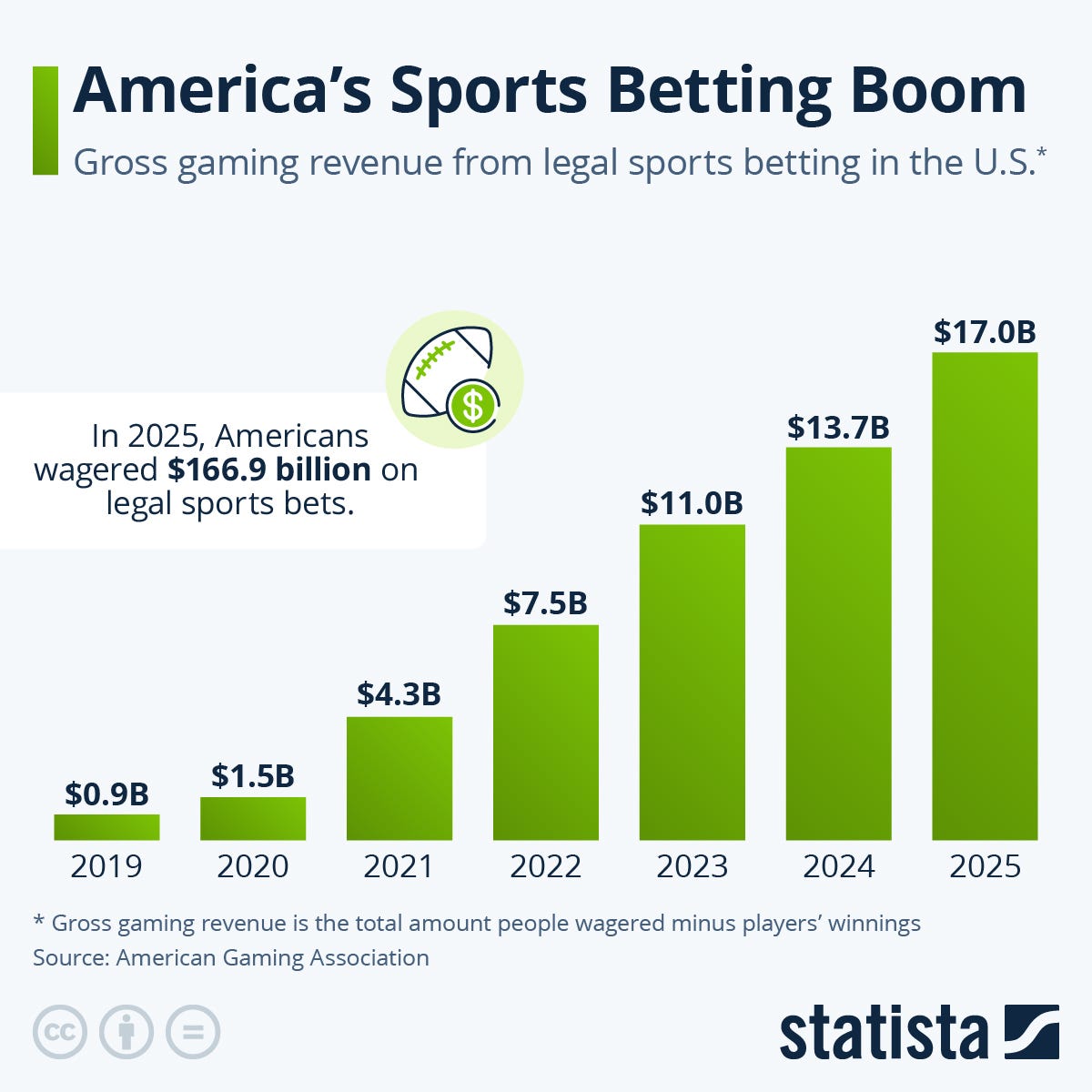
This week’s chart shows it’s now a $17 billion a year industry.
That’s gross gaming revenue from legal U.S. sports betting: dollars wagered minus bettors’ winnings. Put plainly, it’s the money the sportsbooks extracted from the U.S. economy. It grew from $0.9 billion in 2019 to $17.0 billion in 2025, about 19 times bigger in six years. Add up the bars and it’s roughly $56 billion since 2019.
In 2025, Americans wagered $166.9 billion. The house kept about 10 cents of every dollar.
So who’s paying? Mostly the young. Pew found that 31% of adults under 30 bet on sports in the past year (36% of young men), versus 12% of those 65 and older. A Siena/St. Bonaventure poll from February found that 52% of men aged 18 to 49 have an active online sportsbook account. The skew is real, and it’s steep.
Gambling and investing both involve taking risk. The resemblance mostly ends there.
Gambling results in a binary outcome: you win or you lose. When the final whistle blows, your stake is either multiplied or gone. Investing doesn’t work that way. Owning a business (or an index of 500 of them) gives you a claim on earnings that keep coming, and there’s no final whistle.
And the math runs in opposite directions. Sports betting is negative-sum: the platforms’ $17 billion is the bettors’ collective loss. Investing on the whole, though not in every investor’s case, has been a net positive over time. Investors benefit from a growing economy and growing corporate earnings, which drive investment returns. Plenty of individual investors lose money, but the pie keeps getting bigger.
There is one place where the line blurs. Zero-days-to-expiration (0DTE) options expire the same day they’re traded, and held to the close they behave a lot like a sports bet: they either pay off or expire worthless. There’s no long run to bail you out. In July 2026, 0DTE contracts hit a record 66.2% of S&P 500 index (SPX) option volume. A September study by OptionMetrics estimates retail traders account for 30% to 35% of it.
I use options every day, to hedge and to generate income. A same-day lottery ticket on the index is a different animal.
Here’s the irony that bugs me. Younger investors are exactly the people who should be taking more risk. They have decades to recover from market drawdowns and let compounding do the heavy lifting. Time is the one edge they have over the rest of us, and the sportsbook spends it for them.
Some quick math. Say a 25-year-old moves $50 a week from parlays into a broad index fund. At a hypothetical 7% annual return, that’s about $519,000 at age 65. The same $50 a week at the sportsbook, for most a losing proposition, compounds in the other direction.
Joel Goodsen got into Princeton anyway. Most bettors won’t get that lucky.
Investing adds to the accumulation of wealth. Gambling extracts it.
Sources: American Gaming Association via CDC Gaming Reports, “Commercial gaming revenue was new record $78.7 billion in 2025”; Pew Research Center, “Americans increasingly see legal sports betting as a bad thing for society and sports” (Oct. 2, 2025); Siena Research Institute / St. Bonaventure University, American Sports Fan Survey 2026, Release 2; Cboe, “Cboe Global Markets Reports Trading Volume for July 2026” (Aug. 5, 2026); OptionMetrics, “How Much of 0-DTE Is Really Retail? Evidence from SPX and SPY Options” (Sept. 28, 2026); Statista, “America’s Sports Betting Boom.”
🚙 Interesting Drive-By’s 🚙
💡 People Are Rejecting Screens and Returning to Communal Events - Ted Gioia points to a DJ who draws 60,000 people to a stadium while barely moving on stage, plus Joey Politano’s data showing musicians’ income shifting to live shows as digital revenue collapses, and his read is that the crowd itself is the product (the in-person economy is the one part of culture AI can’t stream).
💰 The Shrugflation Triangle: How AI, Oil, and Treasuries are Impacting the Economy - Kyla Scanlon ties oil, AI and Treasuries into one loop where the two biggest borrowers (Washington and the AI builders) shrug off higher rates while everyone else pays them, and the detail retirees should notice is where the AI debt is landing: SpaceX’s $40 billion chip loan is investment grade, so insurers and pension funds can buy it (hidden risk in the part of the portfolio that’s supposed to be boring).
🚀 Tesla Unveils Flying Car - Tesla’s new Roadster flipped through the air on SpaceX thrusters and claims 0-60 in 0.81 seconds, but the part worth watching is the plumbing (SpaceX tanks, Optimus actuators, Terafab chips) that makes a Tesla-SpaceX merger look less like a rumor, and the part worth discounting is the 2028 production date on a flying version that isn’t street-legal.
🤔 Runway: Learning From Watching the World - Packy McCormick and Runway’s co-CEO make the case that AI trained on endless video can learn physics well enough to run robots, which is a smart answer to robotics’ data shortage, but read it knowing Runway is the newsletter’s paying sponsor and every growth number in it (like $100 million of new annual revenue in one quarter) is the company’s own.
💡 This is 74: Mountaineer, Conductor, Painter and more - Dierdre Wolownick (Alex Honnold’s mom, and in 2017 the oldest woman to climb El Capitan) says age only matters for counting birthday candles as long as your health holds, and her honest catch is the retirement risk few people plan for: the longer you live, “the lonelier you get.”
👋🏼 Parting Thought
If you have any cool articles or ideas that might be interesting for future Sunday Drive-by’s, please send them along or tweet ‘em (X ‘em?) at me.
Please note that the content in The Sunday Drive is intended for informational purposes only, and is in no way intended to be financial, legal, tax, marital, or even cooking advice. Consult your own professionals as needed. The views expressed in The Sunday Drive are mine alone, and are not necessarily the views of Investment Research Partners.
I hope you have a relaxing weekend and a great week ahead. See you next Sunday...
Your faithful financial provocateur,
-Mike
If you enjoy the Sunday Drive, I’d be honored if you’d share it with others.
If this was forwarded to you, please subscribe and join the other geniuses who are reading this newsletter.