


👋🏼 Hello friends! Let’s enjoy another Sunday Drive around the Internet.
🎶 Vibin’
No related theme this week. I’m just vibin’ to a performance by two of my favorite blues artists, Bonnie Raitt and Keb Mo’ and their live rendition of No Gettin’ Over You, which Bonnie wrote. Best improvised line from the tune? “Blues for Breakfast”… Enjoy.
💭 Quote of the Week
“Perfection is not attainable, but if we chase perfection we can catch excellence.”
— Vince Lombardi
📈 Chart of the Week
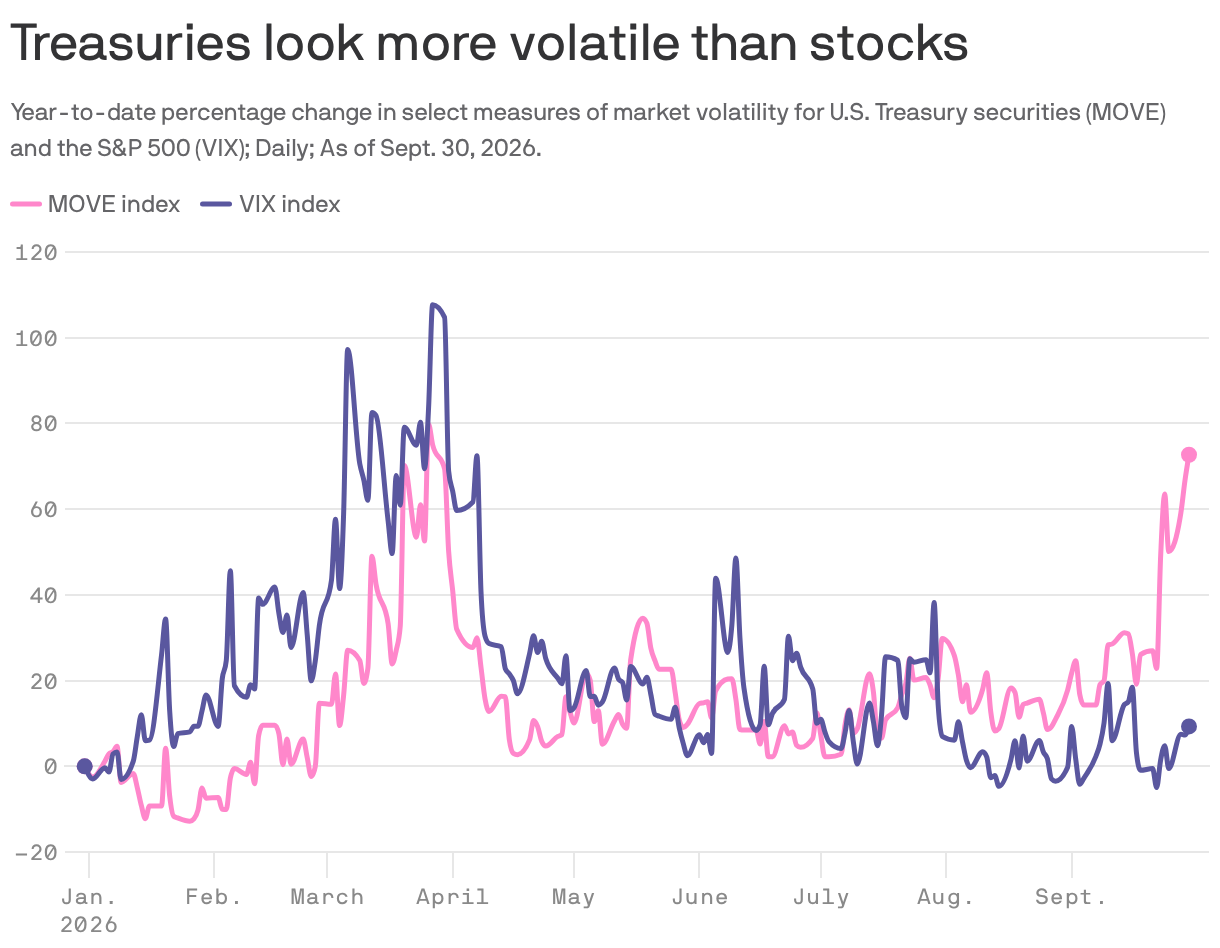
The Shock Absorber Is Shaking
Stock investors expect drama. Bond investors usually don’t. This week’s chart shows that deal is on shaky ground.
Through September 30, the MOVE index (the bond market’s version of the VIX, measuring expected swings in Treasury yields) was up about 73% for the year. The VIX was up about 9%. Rewind to late March, with the Middle East war in its second month: the VIX was up more than 100% and bonds were the calm ones. Six months later, they’ve traded places.
A caveat for the purists. MOVE is quoted in basis points of yield and the VIX in percent of price, so the raw levels don’t compare. Here’s my back-of-envelope translation. A MOVE near 105 implies yields swinging about 1.05 percentage points a year. On a 10-year Treasury (duration of roughly 7.7), that’s about 8% price volatility, half the VIX’s 16. On the 30-year (duration near 14.5), it’s about 15%. That’s equity-sized volatility in the asset you bought to avoid equity volatility.
So what’s rattling the long end of the yield curve? Four things, arriving together:
The Fed raised rates on September 16, its first hike in three years, and at month-end markets put the odds of another in October at about 70%.
The Bank of Japan is tightening. This is forcing a continued unwinding of the so-called “Yen Carry Trade”, and what Ed Yardeni calls the “Revenge of the Bond Vigilantes.”
Washington’s interest bill is about $1.1 trillion a year, up from $300 billion at the end of 2018.
The 30-year Treasury hit 5.50% on September 24, its highest since 2004. It finished this week near 5.6%.
Yardeni also notes that inflation expectations have barely moved. That points to term premium: investors want more yield to compensate for lending long to a government that keeps borrowing.
And the cushion? The iShares 20+ Year Treasury Bond ETF (TLT) was down 9.8% for the year as of September 28, at its lowest close since its 2002 launch. Long bonds are supposed to protect you when the shock is weak growth. When the shock is inflation or the government’s balance sheet, stocks and bonds fall together. Ask anyone who owned a 60/40 portfolio in 2022.
Stocks have shrugged so far, mostly because analysts expect third-quarter S&P 500 earnings to grow 29%. Morgan Stanley’s Andrew Pauker says “Equities can tolerate 5% yields if growth is strong,” but the scenario to avoid is “an accelerated move higher in the long end.”
We take a risk first approach to investing. Dennis DeBusschere of 22V Research says recession risk “could increase materially if 10yr yields move quickly above the ~5.5% level.” The 10-year closed Friday near 5.25%. Add a fast quarter-point and the shrugging could very well stop, with stocks and bonds falling together.
The better path is a Fed pause, a calmer Japan, and a MOVE that drifts back down, the way it did after the spring spike.
I suggest that at 5.25%, a 10-year Treasury can absorb roughly a two-thirds-point rise in yields over a year before its total return goes negative. That’s a real cushion, and it comes from income. For protection against a stock selloff, I want something built to pay off when stocks fall. Bonds used to do both jobs. Right now they’re doing one.
James Carville said in 1993 that he wanted to come back as the bond market, because “you can intimidate everybody.” Thirty-three years later, the bond market is still at it.
Sources: Axios, “Bond market zig zags threaten S&P 500’s smooth ride” (Matt Phillips, Oct. 2, 2026); Benzinga, “MOVE Index Tops 100: Bond Volatility Gauge Jumps 35%”; Saxo, “Bond vol overtakes equity vol,” Sept. 25, 2026; Saxo, “Bond vol rose, bonds barely moved,” Sept. 30, 2026; investingLive, “FOMC rate decision: Fed hikes for the first time in three years”; TheStreet, Stock Market Today, Oct. 9, 2026; Bloomberg News, Sept. 29, Yardeni Interview.
🚙 Interesting Drive-By’s 🚙
💰 From TINA To TIGA: Diversification Pays Again - The 10-year Treasury yields 5.3%, the S&P 500’s forward earnings yield is 5.2% and the CAPE sits at 41.5 (the 1999 peak of 44 led to a decade of -0.9% a year), so Michael Lebowitz is right that stock investors are getting paid “zero premium” for the risk, and a retiree who can lock in 5% from Treasuries no longer needs a stock-heavy portfolio to hit the number.
🤓 Exploring Apprenticeship Growth during the Past Two Economic Expansions - Registered apprenticeships grew 26% nationally from 2021 to 2025 with construction carrying the load, but the St. Louis Fed’s numbers bury two warnings: computer and math apprenticeships fell almost 60% over the same stretch, and only 46% of apprentices finish (the build-out is hiring hands while the entry-level tech ladder loses rungs).
🤔 If you are reading this, congratulations (and thank you) - Alex Berenson cites nonfiction sales in England down about 25% from 2019 to 2025 and warns that “a post-literate world doesn’t reward challenge or difficulty,” which for investors means the simple story with one villain keeps beating the careful argument (so, thank you for reading this far).
🤔 Why Were Victorian Elites So Effective? - The men who ran the richest country on earth went to Oxbridge when nearly everyone who applied got in, worked a few hours a day and spent February to July at balls that peaked after 1am, and Samuel Hughes makes a real case that the networking was the work (a useful thought if AI ever hands the rest of us a Victorian-length workday).
🚀 New Satellite Engine Could Use Earth’s Atmosphere as Fuel To Stay in Orbit Indefinitely - So far it’s a vacuum-chamber test on 50-60 watts, but if a satellite can turn the drag killing it into fuel, the binding constraint on low-orbit constellations (asset life, not launch cost) starts to disappear.
👋🏼 Parting Thought
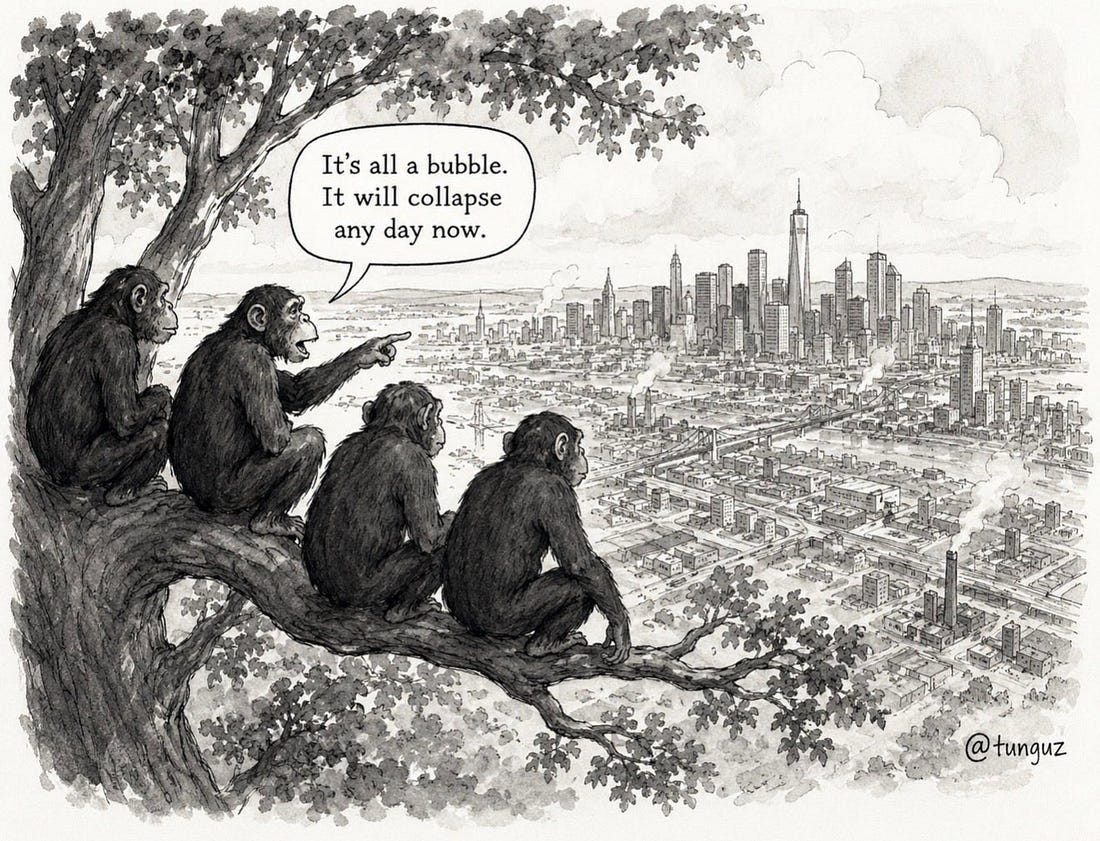
If you have any cool articles or ideas that might be interesting for future Sunday Drive-by’s, please send them along or tweet ‘em (X ‘em?) at me.
Please note that the content in The Sunday Drive is intended for informational purposes only, and is in no way intended to be financial, legal, tax, marital, or even cooking advice. Consult your own professionals as needed. The views expressed in The Sunday Drive are mine alone, and are not necessarily the views of Investment Research Partners.
I hope you have a relaxing weekend and a great week ahead. See you next Sunday...
Your faithful financial provocateur,
-Mike
If you enjoy the Sunday Drive, I’d be honored if you’d share it with others.
If this was forwarded to you, please subscribe and join the other geniuses who are reading this newsletter.