


👋🏼 Hello friends! Let’s enjoy another Sunday Drive around the Internet.
🎶 Vibin’
This weekend we are in my wife’s home town for the wedding of her nephew and his fiancée. It’s always life affirming to see two wide-eyed twenty-somethings start a new life together with all their hopes and dreams ahead of them.
Because I’m a life-long Tom Jones fanboy, because I’m a long time fan of the Art of Noise, because Prince was a bad@$$ songwriter, and because (as you know) I’m a sucker for a good cover…this week I’m vibin’ to Kiss. Enjoy.
💭 Quote of the Week
“We all have our time machines, don’t we. Those that take us back are memories ... And those that carry us forward, are dreams.”
— The Time Machine (2002 film)
📈 Chart of the Week
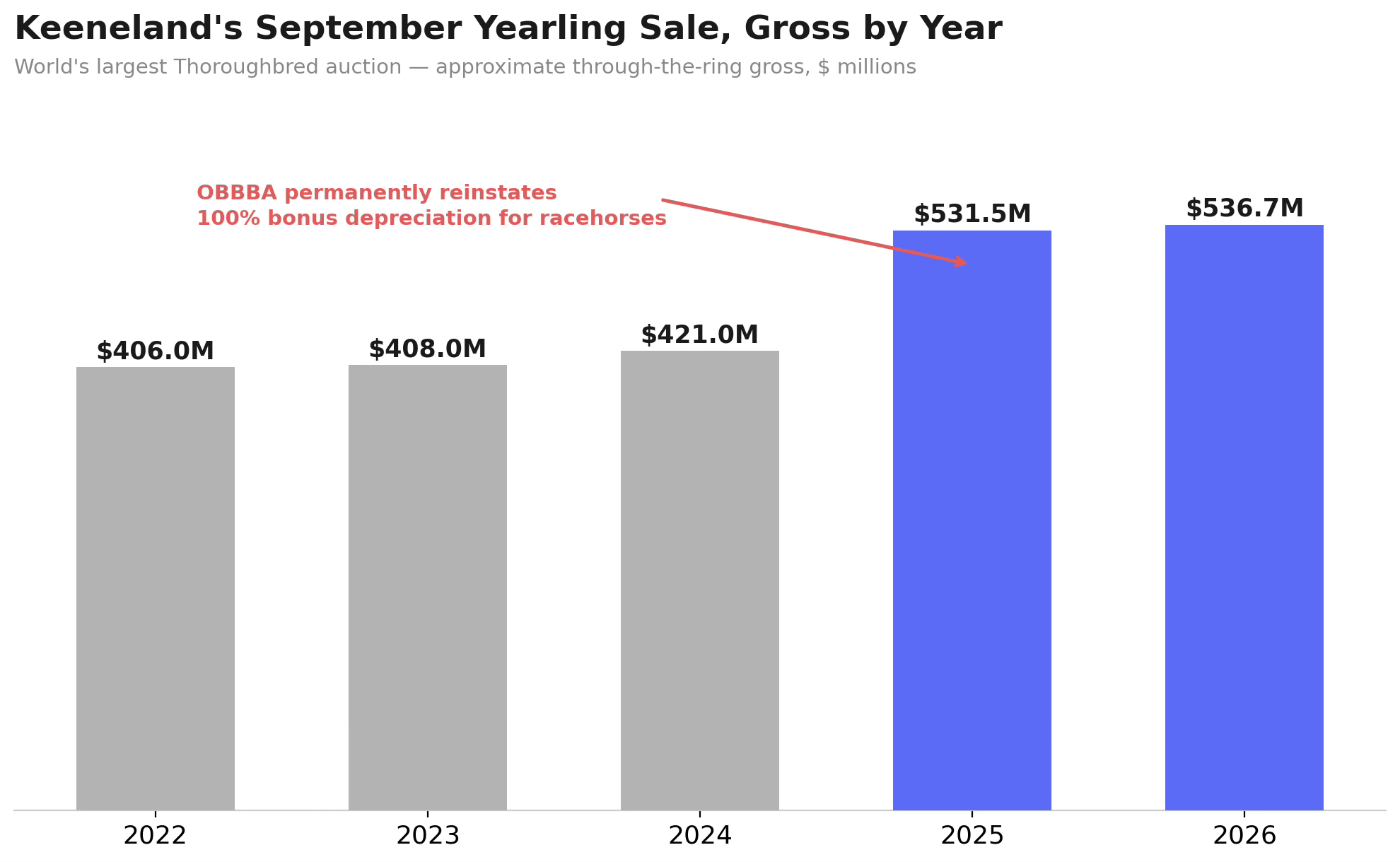
Write-Offs and Long Shots
My colleagues and I have been focusing on a couple of important issues recently. One is the impact that the One Big Beautiful Bill Act (OBBBA) is having on our economic growth. The other is the scrutiny some of the dodgier tax schemes have been getting. This week’s chart brings both to mind.
The Saratoga racing season ended a month ago, but the results of August’s yearling sales are worth a look. They’re about as clean a tax-policy experiment as you’ll find.
The OBBBA made 100% bonus depreciation permanent for property acquired after January 19, 2025. Racehorses count. Buy a $1 million yearling, put it in training, and you can deduct the whole price in year one.
Buyers noticed. Keeneland’s September sale in Lexington, KY grossed $510.5 million through the ring in 2025, up 24% from 2024. (The chart’s 2025 bar, $531.5 million, includes post-sale deals.) This September added another 5%, to a record $536.7 million. Here in Saratoga, the Fasig-Tipton sale grossed $118.2 million in August, up 17%.
The best evidence is what didn’t move. In 2025, Ontario’s yearling sale, where buyers get no U.S. write-off, saw its median fall 21%. And that year the gains piled up at the top: Keeneland’s median rose 14% while the New York-bred median rose 3%.
Now for the fine print. Bonus depreciation moves the deduction forward in time; the total stays the same. Sell the horse (or lose it in a claiming race) and the sale price, up to what you deducted, gets taxed as ordinary income. Losses only offset your salary or portfolio gains if you materially participate; otherwise they sit in the passive bucket. And without a profit in 2 of 7 years, you lose the presumption that your “business” is a business at all.
The states don’t play along either. Kentucky and New York both decouple from bonus depreciation for state income tax. Their help comes elsewhere.
Kentucky exempts breeding stock, and horses under 2 sold to nonresidents, from sales tax. Its historical horse racing machines pay an effective tax of about 7.3%, against 33% to 55% for slots elsewhere, and that money feeds purses.
New York has exempted racehorse purchases from sales tax since 1994. Its New York-bred program runs about 800 restricted races a year and pays breeders up to 40% of a New York-sired winner’s purse, funded by betting handle and video lottery revenue. I’d bet those awards are a big reason the New York-bred sale set a record median of $100,000 this year.
So can a racehorse make money? Rarely. An Australian study of about 3,000 yearlings sold in 2003 found that only 6.3% of the most expensive ones earned back their purchase price, before a dime of training bills. On the seller side, University of Kentucky researchers found that fewer than half of 74,789 U.S. yearling sales from 2001 to 2018 turned a profit for the breeder.
Here’s my take. A tax break this well known gets baked into the price, so much of it flows to the breeders selling the horses. And Uncle Sam covers at most 37% of your loss; you eat the rest.
My rule for any investment: merit first, tax second. If the deal only works after taxes, it’s a hobby. Hobbies are fine, but it’s important to budget for yours like one.
There’s an old joke on the backstretch: the easiest way to make a small fortune in horse racing is to start with a large one.
Sources: Genuine Impact, “The Weirdest Bull Market You Haven’t Heard About: Racehorses”; Keeneland, 2026 September Sale results; Keeneland, 2025 September Sale results; Fasig-Tipton, 2026 Saratoga Sale statistics; NYTB, 2026 New York-bred sale results; Paulick Report, “100 Percent Bonus Depreciation Drives Demand for Quality at Sales”; NJCPA, “No Horsing Around” (OBBBA, placed-in-service and hobby-loss rules); Dean Dorton, depreciation for Thoroughbred owners; State bonus depreciation conformity table (NY and KY); KRS 139.531, Kentucky sales tax and the horse industry; NY Tax Dept. TSB-M-95(6)S, racehorse sales tax exemption; OwnerView, New York incentive programs; Paulick Report, Australian yearling ROI study (2011); Bryant and Stowe, “Estimated Profitability of Thoroughbred Yearlings Sold in Auctions in the United States, 2001-2018,” Sustainability (2020).
🚙 Interesting Drive-By’s 🚙
🎯 Revitalizing America’s Markets at 250 - SEC Chairman Paul Atkins says U.S. listings have fallen roughly 40% since the mid-1990s and public investments are now “concentrated in a handful of companies,” so index investors own a narrower slice of the economy while the growth stays private.
💰 Who Gets Paid When AI Does the Shopping? - Amazon’s $69B in 2025 ad revenue was roughly double its $34B operating income outside AWS, and that ad business is exactly the profit pool AI shopping assistants go after (a16z’s math, and a16z is betting on the assistants).
📉 AI and the Fall? of the Creative Class - America has shed more than 200k creative-industry jobs in 4 years without a recession (Hollywood alone is down nearly a third), and Joseph Politano’s uncomfortable point is that the trillions bet on AI only pay off if the damage spreads to bigger professions.
🤔 The 1990s and the Internet - Arnold Kling quit Freddie Mac in 1994 to build a website on the bet that everything would move online and first movers would own it, and his line on Sun Microsystems (”being right helped destroy it”) is the best one-liner I’ve seen for today’s AI build-out.
🚀 Fork 4: Earth vs. The Stars - Peter Diamandis pitches SpaceX as the railroad to the solar system, but Starship’s $100-200/kg is, in his own words, “a design target, not an achieved price,” and the real railroads opened the West while bankrupting plenty of their bondholders.
💡 I Have Been Writing About AI For 6 Years: Something Changed This Summer - Alberto Romero borrows Scott Aaronson’s line that the singularity is “wildly unevenly distributed,” which is why one person sees a nothingburger and another sees the end of history (and exactly how risk hides in plain sight).
👋🏼 Parting Thought
This week, my friend, mentor, sharer of the same birthday, and the big brother I never had, finally succumbed to the cancer dragon he had so valiantly battled for so long.
To the Dragon Slayer, I say, “Lay down your sword and rest, my friend. I hope you will look down on all of us who loved and admired you and know that we truly believe that the world is a much poorer place without you in it.” Love you, DWR. RIP ❤️

If you have any cool articles or ideas that might be interesting for future Sunday Drive-by’s, please send them along or tweet ‘em (X ‘em?) at me.
Please note that the content in The Sunday Drive is intended for informational purposes only, and is in no way intended to be financial, legal, tax, marital, or even cooking advice. Consult your own professionals as needed. The views expressed in The Sunday Drive are mine alone, and are not necessarily the views of Investment Research Partners.
I hope you have a relaxing weekend and a great week ahead. See you next Sunday...
Your faithful financial provocateur,
-Mike
If you enjoy the Sunday Drive, I’d be honored if you’d share it with others.
If this was forwarded to you, please subscribe and join the other geniuses who are reading this newsletter.