


👋🏼 Hello friends! Let’s enjoy another Sunday Drive around the Internet.
🎶 Vibin’
Interest rates keep going up. Not because of the Fed’s recent increase in the Fed Funds Rate which they control. I believe it’s because of the twin forces of inflationary pressures from the conflict in the Middle East (elevated diesel prices affect the overall economy much more than elevated gasoline prices) and an inexplicable and ongoing “Energy Bunny” sort of growth in the economy.
So, this week I’m vibin’ to the Red Hot Chili Peppers cover of Stevie Wonder’s hit, Higher Ground. I chose the cover rather than the original because of its chaotic representation of the song. ‘Cuz it feels like that’s where we live right now.
💭 Quote of the Week
"Not everything that can be counted counts, and not everything that counts can be counted." — William Bruce Cameron
*** BONUS QUOTE ***
"Nobody cares how tax-efficient a bad investment is." — Brent Sullivan
📈 Chart of the Week
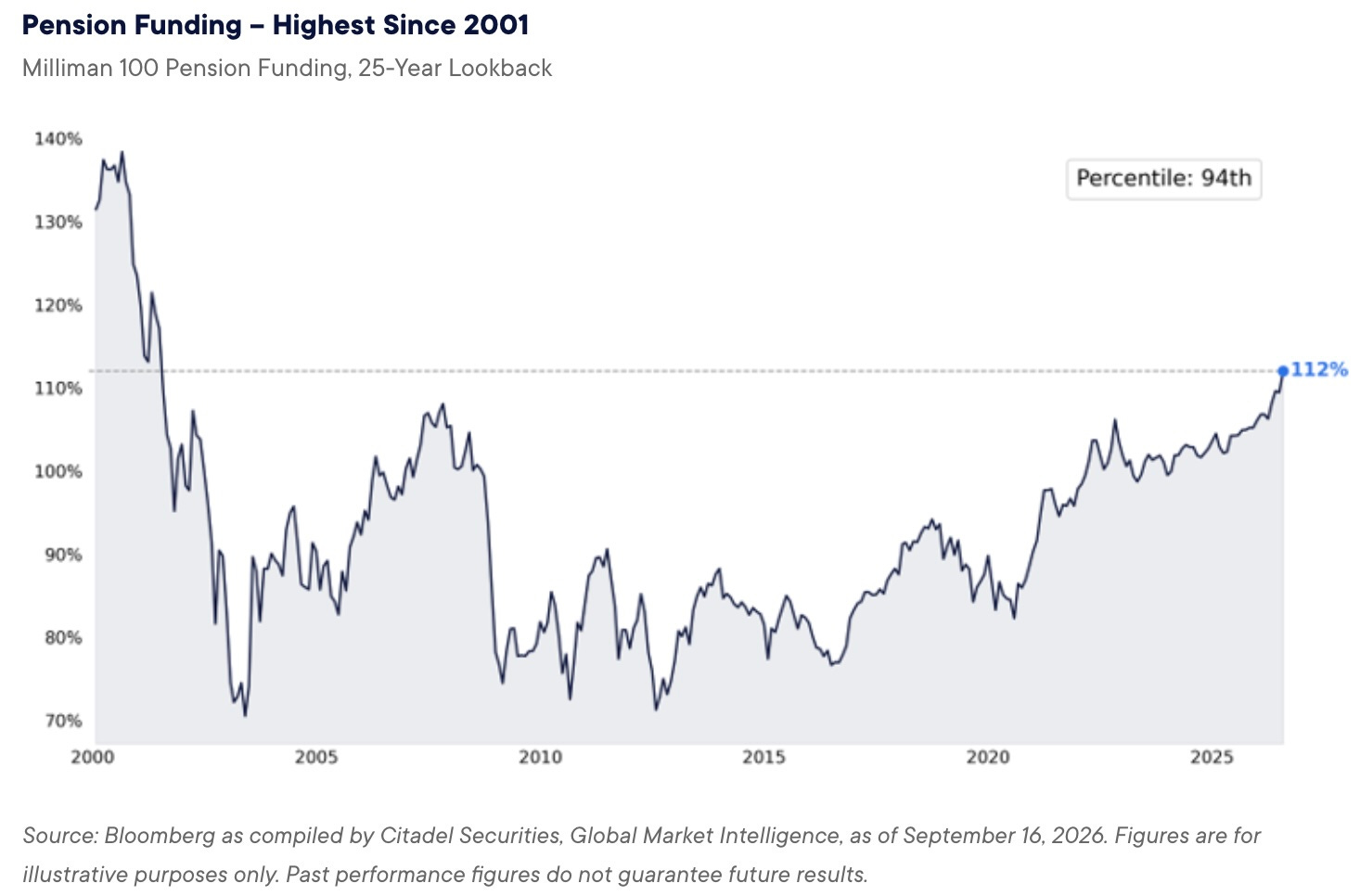
Winning the Game
William Bernstein’s old advice to investors: once you’ve won the game, stop playing. Corporate pension plans just won the game.
This week’s chart shows the Milliman 100, the 100 largest U.S. corporate pension plans. They’re about 112% funded, the highest level since 2001. Milliman puts the surplus at $141 billion as of August 31. A year earlier the funded ratio was 104.9%.
Two things did the heavy lifting. A strong stock market grew the assets, and the discount rate used to value pension liabilities climbed to 6.00%, which shrinks the present value of what plans owe. Rising assets and shrinking liabilities is about as good as it gets for a pension actuary.
So what does a plan sponsor do with a surplus? Lock it in.
That could be a risk for equities, and it’s mechanical. When stocks outperform bonds, a plan’s equity weight drifts above target and gets trimmed back. Citadel Securities notes that strong funding pushes plans to “de-glide” and immunize portfolios, creating the potential for mechanical equity selling and fixed income buying, especially around quarter-end.
“De-glide” is the word I’d underline. Most corporate plans run a glide path: every time funded status crosses a trigger, they permanently move money out of stocks and into long bonds that match their liabilities. Quarterly rebalancing reverses when markets turn. Glide-path moves usually don’t.
Twenty years ago, the Milliman 100 plans held 61.7% of their assets in stocks and 28.6% in bonds. By the end of 2025 that had flipped: 24.1% in stocks and 52.7% in bonds. That trend has run one way for 20 years.
The other 23.3% is a grab bag of real estate, private equity and debt, hedge funds, commodities, and cash. That bucket has more than doubled since 2005, much of it can’t be sold quickly, and Milliman notes the companies’ SEC filings generally don’t say what’s in it. So when a plan trims risk, the selling lands on what it can actually trade, and public stocks are the easiest thing to sell.
And bonds are worth owning again. As of September 24, Treasury yields were above 5% from the 5-year out to the 30-year, with the 10-year at 5.18%. The 10-year TIPS yield was 2.85%, a real return you can lock in for a decade. For a plan that’s already won, a contractual 5% beats swinging for the fences.
Now, the case against my own argument. JPMorgan pegged June’s quarter-end rebalance at roughly $165 billion of net global equity selling. U.S. pensions were about $55 billion of it, with Japan’s and Norway’s giant funds and the Swiss National Bank supplying most of the rest. That sounds like a lot until you set it against a U.S. stock market worth something like $65 to $70 trillion. The U.S. pension piece is less than 0.1% of that, and buybacks and dip-buyers can absorb it.
And the rest of the institutional crowd hasn’t won the game. Milliman has the 100 largest public pension plans at 88.2% funded, an $816 billion hole. College endowments ($944 billion across 657 schools) keep about 86% in equities and equity-like strategies, and they spent 4.9% of assets last year. Private foundations have to pay out 5% a year. A 2.85% real yield doesn’t fund that, so don’t expect endowments and foundations to join the selling in size. They’ll rebalance at the margin, but they run no glide path.
What I expect is a missing buyer. Over the next few quarters, the most patient institutional money in the country keeps walking from stocks toward bonds, at a time when equities are priced for perfection and bonds are earning real money again. My guess is that shows up as sloppier quarter-ends, a lower ceiling on stock multiples, and perhaps steadier demand for the long end of the yield curve.
The same math applies to individuals approaching retirement. If you’ve already won the game, it’s worth asking how best to “de-glide” (and, in a taxable account, how to step back without handing a big slice of the winnings to the IRS).
Sources: Milliman Pension Funding Index, September 2026; Milliman 2026 Corporate Pension Funding Study; Milliman Public Pension Funding Index, 7/31/2026; Citadel Securities, “September Setup: The Asymmetry Has Changed” (8/31/2026); Treasury yields as of 9/24/2026 (Forbes Advisor); 10-year TIPS yield, FRED DFII10; JPMorgan quarter-end rebalancing estimate via Investing.com (June 2026); U.S. market cap context, 24/7 Wall St. (6/22/2026); FY25 NACUBO-Commonfund Study of Endowments; Mercer summary of the FY25 NACUBO-Commonfund Study.
🚙 Interesting Drive-By’s 🚙
💸 The Reindustrialization of America Is Underway - Apollo pegs the cost of rebuilding US industrial capacity at $2 trillion to $6.5 trillion as manufacturing has slid from roughly 28% of GDP in the 1950s to about 9% today, a real Silicon Industrials trend worth owning, but read that number as the size of the opportunity the firm wants to finance, not a settled forecast.
👀 Abbott put Texas data centers on ice until his power grid audit finishes - Texas just froze new data-center permits pending an ERCOT grid audit (due back Oct 19) as an NBC poll found 64% of Americans less likely to vote for a candidate who backs local data centers, a reminder that the AI-capex bull case has priced chips, power, and capital but not permits and voter backlash, the layer that freezes fastest.
🤔 A Practical Take on Longevity for Advisors & Clients - The piece counts more than 200,000 waking hours ahead for a 65-year-old who reaches 100 and urges advisors to plan for it, but longevity optimism is itself a planning risk: building a retirement around the best case when the median falls well short is its own failure mode, so plan the distribution, not the dream.
💡 Sidestepping - In a guest post on Chip Conley’s Wisdom Well, a mother realizes her grown daughters have “hired me back, unofficially, as an advisor,” a quiet lesson that the shift from managing to being asked, from correcting to bearing witness, is the same patience a risk-first strategy (and a good advisor) demands.
🤔 Safety in Numbness: why disagreeing with LLMs is a good sign - Azeem Azhar argues that LLMs, like the MFA programs that grew from 15 in 1975 to 250 by 2012, norm everyone toward the middle of a distribution where outliers are unwelcome, so consistently disagreeing with the model is a sign you are still thinking from the edge, which is exactly where investing alpha lives.
👋🏼 Parting Thought
My family and I are in Ft. Worth, TX this weekend for a (long overdue) family reunion. H/T to our daughter for inspiring this week’s Parting Thought.

If you have any cool articles or ideas that might be interesting for future Sunday Drive-by’s, please send them along or tweet ‘em (X ‘em?) at me.
Please note that the content in The Sunday Drive is intended for informational purposes only, and is in no way intended to be financial, legal, tax, marital, or even cooking advice. Consult your own professionals as needed. The views expressed in The Sunday Drive are mine alone, and are not necessarily the views of Investment Research Partners.
I hope you have a relaxing weekend and a great week ahead. See you next Sunday...
Your faithful financial provocateur,
-Mike
If you enjoy the Sunday Drive, I’d be honored if you’d share it with others.
If this was forwarded to you, please subscribe and join the other geniuses who are reading this newsletter.