


👋🏼 Hello friends! Let’s enjoy another Sunday Drive around the Internet.
🎶 Vibin’
Lately, we’ve seen a whirlwind of mixed messages on the economy, AI, and financial markets in general. Sorting out the signal from the noise is never easy, but it feels harder than ever these days.
With that in mind, I figured we were due for a good ol’ fashioned mashup video. So this week, I’m vibin’ to Stayin’ in Black, the Bee Gees + AC/DC. Enjoy.
💭 Quote of the Week
“If you think this has a happy ending, you haven’t been paying attention.”
— Ramsay Bolton
📈 Chart of the Week
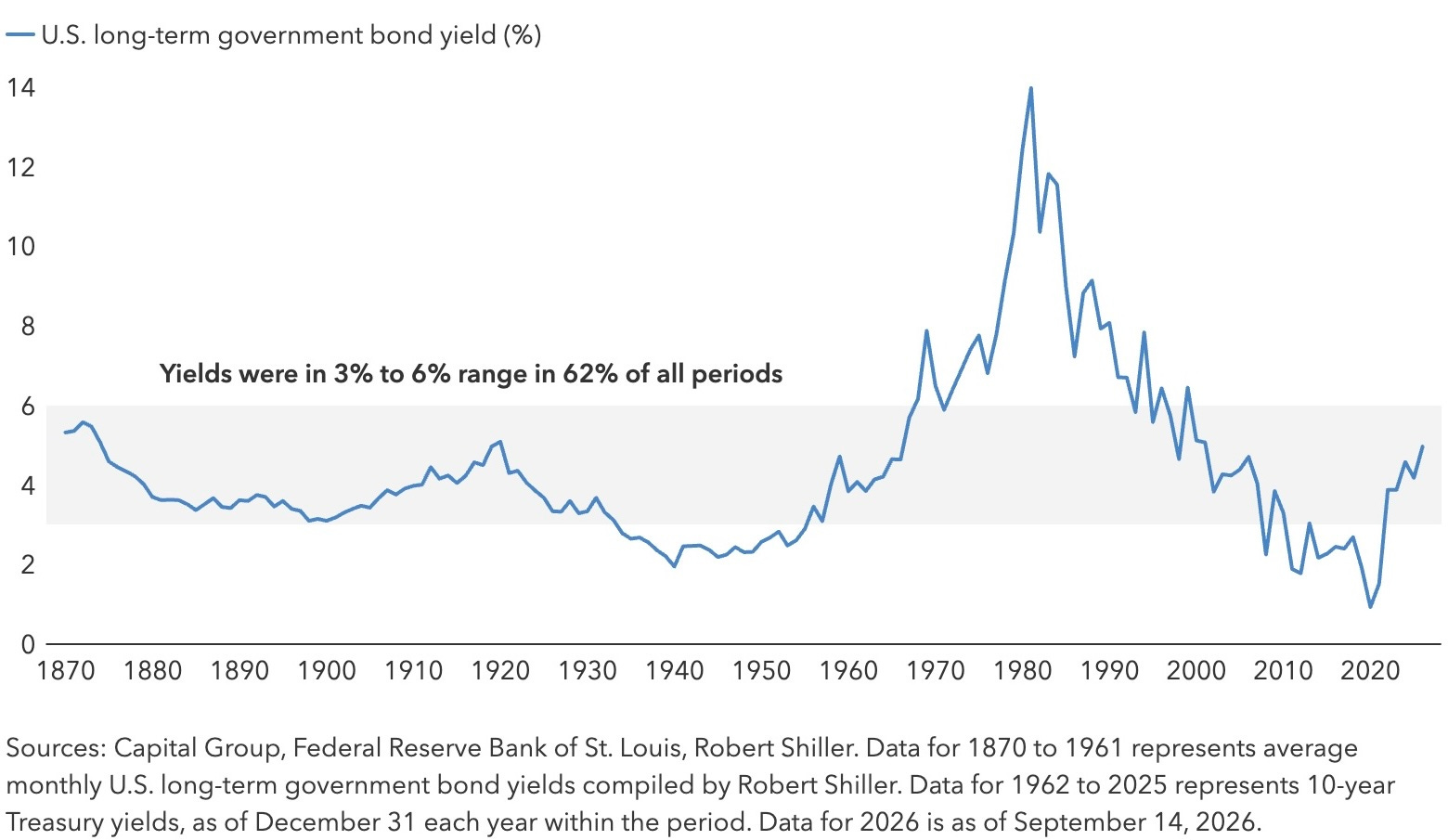
A Long Term Look at “Normal”
Pull back far enough and the panic about “high rates” starts to look a little silly.
This week’s chart runs from 1870 to today. That’s 156 years of what it cost Uncle Sam to borrow for the long haul. The shaded band marks 3% to 6%. Yields sat inside it 62% of the time.
The 10-year bond yield is sitting around 5% right now. That puts us square in the middle of the fairway.
The abnormal stretch on this chart is the decade and a half we just left. After the Great Financial Crisis, and again after Covid, rates fell to places they’d never been in a century and a half. The 10-year kissed roughly 1% in 2020. Money was basically free. Savers got nothing. And a whole generation of investors, borrowers, and corporate treasurers wired their assumptions to a number history says almost never shows up.
The spike the other way was just as strange. Yields ran to nearly 14% in 1981, when Volcker was breaking the back of inflation. I don’t think we can file that under normal either.
So we spent 15 years anchored to one extreme, and now we’re drifting back toward the boring middle. I think that’s healthy. Well priced risk is also healthy. When capital costs something, people allocate it with more care.
So now have to talk about the Fed, because someone always asks.
Everyone seems to want to trace the long end back to the last FOMC meeting. I think that’s mostly noise. The Fed has real command of the short end of the curve. The long end answers to a different set of bosses: inflation expectations, the term premium investors demand for locking up money a decade at a time, the economic growth outlook, and the sheer flood of Treasury supply Washington keeps issuing.
The recent bump in the funds rate will tug the front of the curve around. My view is it does little lasting damage, or good, to the 10-year. If long rates keep climbing from here, the culprit is fiscal deficits and inflation risk, not the people setting the overnight rate.
We think of risk first, because that’s our job. A 5% world only hurts if you spent the free-money years betting it would last forever. Very long-duration portfolios, business models that only work at zero, real estate underwritten at 3% into eternity. Those are what crack when normal comes back.
For everyone else, this is good news wearing a scary costume. Bonds pay again. Cash pays again. The tradeoff between reaching for risk and sitting in safety actually works.
Rates came home. The hard part is we forgot what home looked like.
Sources: Capital Group, Federal Reserve Bank of St. Louis, Robert Shiller. Long-term U.S. government bond yields, 1870 to 2026 (10-year Treasury from 1962; 2026 data as of 9/14/2026).
🚙 Interesting Drive-By’s 🚙
💸 Ground Broken on a Rust Belt Powerhouse - A dying Pennsylvania coal town gets a $10 billion, 2-gigawatt AI data center on 660 acres, the concrete reminder that the AI trade is a power-and-land story where 68% local opposition and strained grids are the friction the market is not pricing.
🤔 It’s Hard to Wipe Out Humanity, Even for Super AI - Pethokoukis writes from a pro-progress brand, so treat him as the doomers’ mirror image, but his demand is the keeper: anyone claiming superintelligence ends the species should show the concrete step-by-step mechanism before we halt development.
🎯 No Blanket Immunity for AI Companies, Ever - Berenson runs deliberately hot, but the point holds: keep the labs liable rather than granting a “responsible AI” safe harbor, because a lab-written immunity standard is a margin moat that shifts the cost of failure onto the public.
💰 Stop Panicking About AI - The AI doom is loudest from the executives racing to multi-trillion-dollar IPOs, so follow the money, because catastrophizing conveniently argues for fewer competitors and lighter antitrust while ordinary liability would do the real work.
💡 The Second Retirement Nobody Talks About - Buck’s frame is that retirement has a second phase almost nobody plans for, a shift around age 80 when the danger is mismatching the spending curve to the health curve, because the biggest bills (the $3,800 to $7,000-plus monthly care years) tend to arrive when the portfolio has the least runway to recover.
📈 Interest Rates Can’t Take Down the US Economy Anymore - Pompliano is talking his book (the piece routes into crypto-backed loan products), and “rates can’t bite anymore” is textbook this-time-is-different, but the half-true kernel worth engaging is that an asset-light, tech-weighted economy may respond to Fed tightening with longer and more muted lags.
👋🏼 Parting Thought
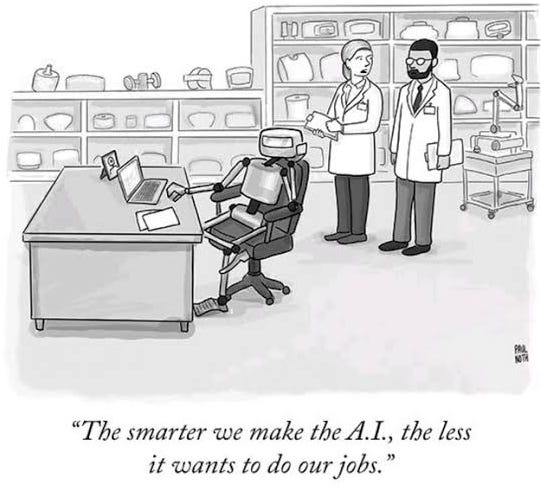
If you have any cool articles or ideas that might be interesting for future Sunday Drive-by’s, please send them along or tweet ‘em (X ‘em?) at me.
Please note that the content in The Sunday Drive is intended for informational purposes only, and is in no way intended to be financial, legal, tax, marital, or even cooking advice. Consult your own professionals as needed. The views expressed in The Sunday Drive are mine alone, and are not necessarily the views of Investment Research Partners.
I hope you have a relaxing weekend and a great week ahead. See you next Sunday...
Your faithful financial provocateur,
-Mike
If you enjoy the Sunday Drive, I’d be honored if you’d share it with others.
If this was forwarded to you, please subscribe and join the other geniuses who are reading this newsletter.