


👋🏼 Hello friends! Let’s enjoy another Sunday Drive around the Internet.
🎶 Vibin’
In terms of volatility, markets are channeling Alfred E. Neuman and seem to be in full “What, me worry?” mode.
This week I’m vibin’ to Call Me the Breeze by Lynyrd Skynyrd from 1974, here in a loose live take with ZZ Top’s Billy Gibbons sitting in. It’s J.J. Cale’s ode to having no worries, no plans, and no fixed address. Sounds about right for this market.
💭 Quote of the Week
“The riskiest thing in the world is the widespread belief that there’s no risk.”
— Howard Marks
📈 Chart of the Week
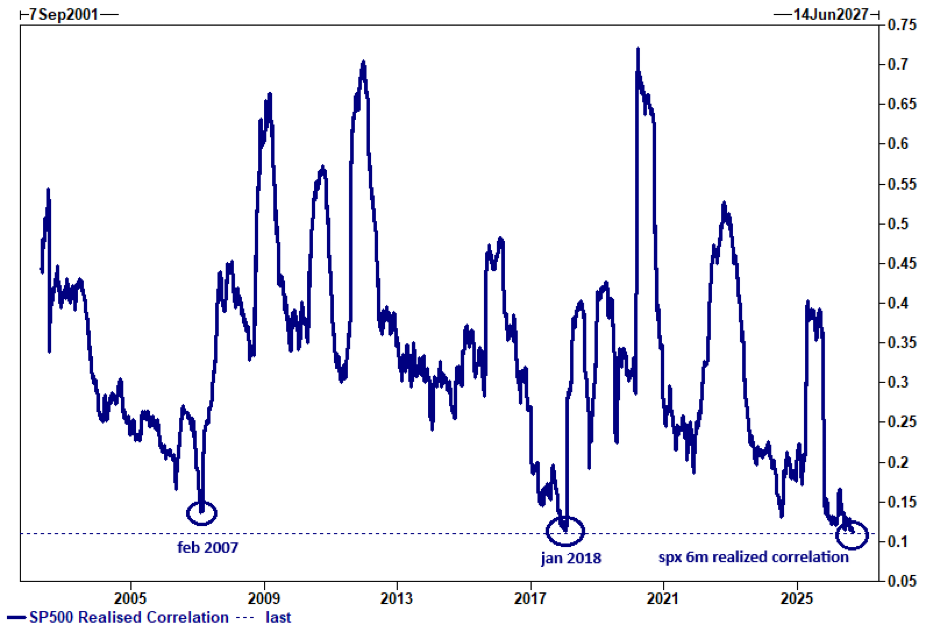
📉 When Everything Moves Together
This week’s Chart might make one a little uneasy, and that’s precisely because it looks so calm.
Realized correlation across the S&P 500 has fallen to roughly 0.10, one of the lowest readings in 25 years. Stocks are doing their own thing. The AI winners rip, staples drift, energy zigs while tech zags. On the surface, a stock-picker’s paradise.
But consider the last two times correlations sank to these levels. February 2007 and January 2018.
Feb 2007: correlations bottomed. The market felt bulletproof after a long, quiet climb. Then on February 27 an 8.8% drop in Shanghai spilled over, the S&P dropped about 3.5% in a day, and the VIX spiked more than 60%. Markets shrugged it off and made new highs into October. Then correlation went vertical through the 2008 collapse and stayed pinned near 1 as the S&P lost 57%.
Jan 2018: same setup. 2017 was the calmest year on record, and January’s melt-up pushed correlation to the floor. Two weeks later came Volmageddon. The VIX more than doubled on February 5, the short-vol XIV fund got wiped out, and the S&P fell about 10% in nine trading days.
Then COVID, for good measure. Correlation wasn’t at a record low going in, but the mechanism was essentially the same. In March 2020 pretty much everything sold off together, the VIX closed at an all-time high of 82.69, and the S&P dropped 34% in 33 days.
The pattern of returns has been generally consistent, and a little cruel.
Before the trough: strong, steady gains. That’s what drives correlation down in the first place. Individual stories dominate, volatility bleeds out, and diversification looks like it’s working beautifully.
During the trough: more of the same, which is the whole problem. Low correlations are the market’s way of telling us that nobody’s worried about the same thing at the same time.
After the trough: some sort of macro shock arrives and correlations spike. Everything in investors’ portfolios starts moving in lockstep, downward, and the diversification investors thought they had evaporates at the worst possible moment. Across asset classes, the same thing happens. In 2008 credit and equities went down together. In 2022 so did stocks and bonds, the 60/40’s worst year in a generation, maybe ever.
But here’s the message, and I think it matters. Low correlations set the stage. They can’t tell you when the show starts. February 2007 preceded the real damage by more than a year. January 2018 preceded it by two weeks. This week’s Chart tells you the fuel is dry. It says nothing about when the match gets lit.
What’s my take on the current level of 0.10? Cheap insurance. When correlations are this low, so is the cost of protecting against the day they aren’t. That’s usually the best time to buy the hedge nobody wants, back when everybody’s still convinced they don’t need it.
Sources: CNBC, Feb 27 2007 selloff; Bloomberg, “The Day the VIX Doubled” (Volmageddon); CNBC, VIX record close 82.69, Mar 16 2020
🚙 Interesting Drive-By’s 🚙
💸 The Great Health Plan Replacement - Read it as a map of where venture capital wants disruption to go rather than neutral analysis, because a16z is a large investor in exactly the “alternative health plans” it champions here, but the underlying tell is real: AI is collapsing the operational overhead that kept a roughly $1 trillion employer-insurance market sleepy and legacy-dominated for decades, so the biggest fixed cost in most households may finally face real competition.
💡 The Forecaster’s Paradox - Ridley writes from an explicit rational-optimist brand, so the examples are picked to fit the thesis, but the paradox holds and it pays: innovation looks inevitable looking backward yet is almost never predicted looking forward, and the edge hiding in that is that the direction of a durable trend and the timing of its payoff are two different bets.
🤔 Behind Door #2, Everyone Dies - Take the reporting with real skepticism, but even a conservative 1% chance of an extinction-level outcome implies about 80 million lives, that’s some seriously convex tail-risk math.
🤓 The Quiet Turning - Green’s market-structure beat (passive flows quietly distorting price discovery, trust functioning as plumbing) and the Fourth Turning idea of institutions torn down before they are rebuilt, framed here as “what happens when everybody knows that everybody can check.”
🚀 Why Optimists Live Longer - Desalination costs are down more than 70% since 1990 and two SpaceX veterans are pitching a 25-pound, $749 portable unit as the “Starlink of drinking water,” the atoms-innovation cost curve that turns a basic need into an investable abundance story.
🧬 Insilico’s AI-Designed Drug Shows Biological Age Reversal - A genuine convergence: a first-in-class TNIK inhibitor that generative AI took from target to preclinical in roughly 18 months, published in Nature Biotechnology, sitting exactly where the AI, longevity, and demographics stories meet.
👋🏼 Parting Thought
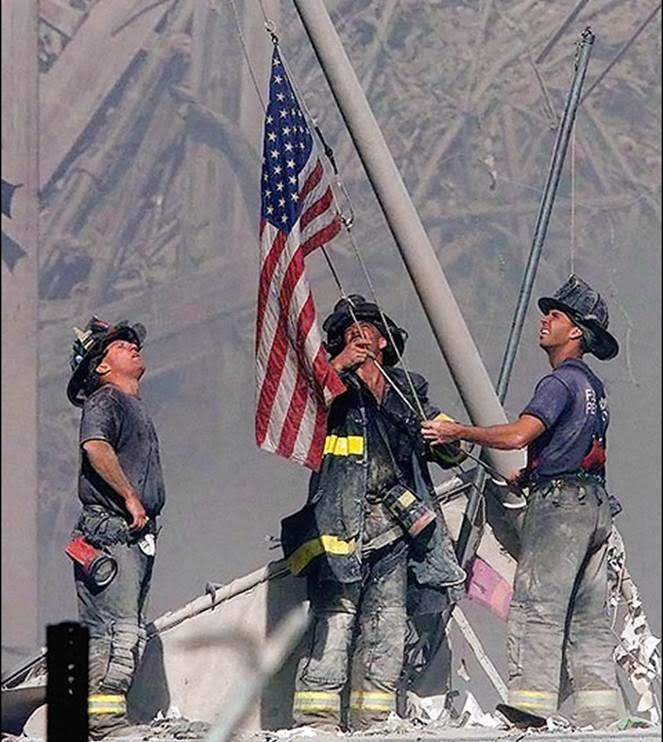
25 years ago this past Friday, 9/11 happened. We must never forget. Everyone who was alive at the time has a story about where they were that fateful day. I have my own.
American Airlines flight 277 - the 5th plane, we were told some time later - was set to depart Boston for San Diego mere minutes before the first ever nationwide ground halt. We had already pushed back from the gate, about to taxi for takeoff. Then the plane stopped and returned to the gate - without explanation.
Myself, my fellow passengers, and the flight crew owe our lives to Ben Sliney, FAA National Operations Manager, who on his first day in that role had the fortitude to do what had never been done, ordering the halt of 4,500 flights across the U.S. I will be forever grateful for what he did that morning 25 years ago.
If you have any cool articles or ideas that might be interesting for future Sunday Drive-by’s, please send them along or tweet ‘em (X ‘em?) at me.
Please note that the content in The Sunday Drive is intended for informational purposes only, and is in no way intended to be financial, legal, tax, marital, or even cooking advice. Consult your own professionals as needed. The views expressed in The Sunday Drive are mine alone, and are not necessarily the views of Investment Research Partners.
I hope you have a relaxing weekend and a great week ahead. See you next Sunday...
Your faithful financial provocateur,
-Mike
If you enjoy the Sunday Drive, I’d be honored if you’d share it with others.
If this was forwarded to you, please subscribe and join the other geniuses who are reading this newsletter.