


👋🏼 Hello friends! As we celebrate this Labor Day weekend, let’s enjoy another Sunday Drive around the Internet.
🎶 Vibin’
It’s Labor Day weekend, and after three straight editions on capital versus labor in the Sunday Drive, the Vibe picks itself. Working Man is the song a Cleveland DJ put on the air in 1974 and turned into the break that got Rush signed, and it still plays like the drive home after a long shift.
This week I’m vibin’ to Working Man by Rush from 1974.
💭 Quote of the Week
“Optimism sounds like a sales pitch. Pessimism sounds like someone trying to help you.” ― Morgan Housel
📈 Chart of the Week
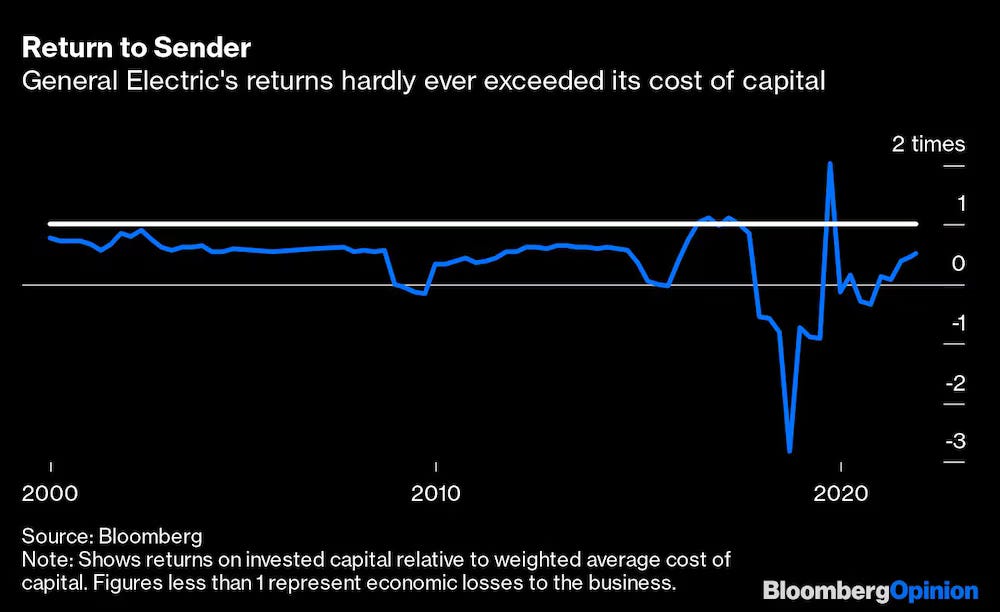
💸 Cassandra and the Capital Cycle
At the risk of sounding a bit Cassandra-esque, I return this week with my cautionary tale of the potential for poor returns on capital in the coming years from the current AI cycle. You may remember Cassandra, a figure from Greek mythology who was cursed to speak the truth and be believed by no one. The capital-cycle warning works the same way. It is accurate, it is old, and it is dull, so it gets waved off right up until it’s too late.
This week’s Chart shows that on only rare occasions over the last couple of decades did GE (pre-2024 breakup), General Electric, a company J.P. Morgan and Thomas Edison built in 1892, earn its cost of capital.
GE historically had one edge: GE could borrow cheaper than anyone, so its customers borrowed cheaply to buy GE machines. The AAA rating held for over 50 years. Then GE Capital grew into the fifth-largest lender in the country, and the strength quietly became the fragility. The empire cheap money built, cheap money eventually broke.
Here’s the takeaway for me. The technology was real at every step. Electricity, jet engines, medical imaging, all genuine, all world-changing. What sank the returns was the money invested. Too much capital, invested and then mis-invested, competing away the very profits that drew it in.
We have seen this movie before. Railroads in the 1870s laid tens of thousands of miles of track and handed shareholders years of losses. Telecom in the late 1990s poured more than $500 billion into fiber, roughly 80 million miles of it, and left something like 85% of it dark and unlit. Bandwidth got cheap, customers won, and the firms that funded the buildout went bankrupt. The internet was real. The payoff to the people who wired it was not.
Which brings us to the current investment cycle. Big tech spent close to $400 billion on AI infrastructure in 2025. Bain estimates data centers will need something like $2 trillion in annual revenue by 2030 to justify the spend. Current AI revenue sits near $20 billion. That gap is no rounding error, to say the least. Meta, Microsoft and Alphabet are each spending more of their revenue on capex than AT&T did at the peak of the telecom bubble.
The trap is that none of them can stop. Ease off while a rival keeps building, and you risk obsolescence. So everyone builds, capacity floods in, and the group competes away the returns it is racing to capture.
The more recent and concerning wrinkle is the addition of significant amounts of debt to fuel the AI investment boom. It was one thing for the big spenders to crash their free cash flow margins. But now, they’ve run way past that with the addition of debt, some direct, some indirect, and they’re doing so by increasingly creative means. This makes me want to bring out my worry beads.
AI may change the world. Whether this much capital, moving this fast, earns a return in excess of its cost is a very different question.
Sources: The Collapse of GE’s House of Debt Was 130 Years Coming (Bloomberg, David Fickling, 2021); Surviving the AI Capex Boom (Sparkline Capital); Parallels Between the Hyperscalers and the Telecom Firms of the 1990s (MOI Global).
🚙 Interesting Drive-By’s 🚙
🤔 Can the ‘Vanguard Effect’ Upend Wealth Management? - The risk-first read is that the “Vanguard effect” cuts against Vanguard: the same investor-owned, cost-obsessed machine that made index funds unbeatable now runs into custody’s thin margins and, worse, the independence problem, because the moment Altruist is seen steering flows to Vanguard funds the RIAs it needs start to walk (one analyst’s flat “some RIAs will leave”), which is the hidden-vs-visible-risk lens on the plumbing under every RIA relationship: the visible win is cheaper advice, the hidden risk is captured architecture.
👀 Vanguard’s Altruist Deal Tells You Where Custody Is Headed - Read the messenger before the message: this is a signed op-ed by the CEO of Apex Fintech, a custody-and-clearing rival, arguing custody has gone from invisible plumbing to strategic differentiator, so the useful signal is not his self-serving thesis but the tell inside it, that even a competitor concedes the tech gap got too wide to build across, which is why Vanguard bought rather than built.
⏰ Is AI a Bubble Yet? Our Five Gauges - The verdict (boom, not bubble) matters less than the scoreboard: Azhar and Warren’s five gauges read zero red and two amber today on roughly $126B of trailing-twelve-month AI revenue, but funding quality has been sliding since September 2025 and their base case flips both funding quality and economic strain red in 2027, so this reads as a countdown more than a green light, with demand the visible green and the financing plumbing the hidden amber.
💸 Follow the Capital: AI Is Becoming a Physical Infrastructure Story - The AI trade has quietly become a construction-and-power story, four hyperscalers carrying north of $700B of 2026 capex while U.S. corporate AI-infrastructure debt has jumped to roughly $220B from about $12.5B in 2025, and Schneider’s tell is the gap between announced and actually built, tracked by satellite: if timelines slip or finished sites sit idle, that is the second-derivative crack that tends to precede a capex correction.
💡 Great Writers Aren’t Obsolete. AI Makes Them More Valuable Than Ever. - Schachtel argues AI writes mediocre prose by design, optimizing for the average likely response and increasingly feeding on its own output, so the contrarian upside buried in the doom is that an independent point of view drawn from lived experience becomes the scarce, appreciating asset exactly as the machine floods the zone with perspective-free copy.
🤔 How many people does synthetic fertilizer feed? - Ritchie’s number is that roughly half the people alive (about 3.5 billion) are fed by crops grown with synthetic nitrogen, so one 1910 industrial process, Haber-Bosch, sits under the entire food supply, a single point of failure most investors never think to price.
👋🏼 Parting Thought

If you have any cool articles or ideas that might be interesting for future Sunday Drive-by’s, please send them along or tweet ‘em (X ‘em?) at me.
Please note that the content in The Sunday Drive is intended for informational purposes only, and is in no way intended to be financial, legal, tax, marital, or even cooking advice. Consult your own professionals as needed. The views expressed in The Sunday Drive are mine alone, and are not necessarily the views of Investment Research Partners.
I hope you have a relaxing weekend and a great week ahead. See you next Sunday...
Your faithful financial provocateur,
-Mike
If you enjoy the Sunday Drive, I’d be honored if you’d share it with others.
If this was forwarded to you, please subscribe and join the other geniuses who are reading this newsletter.