


👋🏼 Hello friends! Let’s enjoy another Sunday Drive around the Internet.
🎶 Vibin’
This week, the world lost a treasure and is a much poorer place without her. I spent the last several days pondering how best to honor the passing of our beloved Dolly Parton. After all, she did write over 3,000 songs. Which one to choose? Jolene? 9-to-5? Coat of Many Colors? I Will Always Love You?
All great choices, but instead I landed on…. a cover: Dolly’s rendition of the un-coverable Stairway to Heaven. While metaphorically appropriate, it’s also a wonderful example of who she was. Not only was she brave enough to cover a song that few dare to try, but in true Dolly-esque fashion, she made it her own. RIP Dolly. We will always love you. 💔
💭 Quote of the Week
“The way I see it, if you want the rainbow, you gotta put up with the rain.”
— Dolly Parton
📈 Chart of the Week
👶 The Baby Bummer Meets the Machines
I firmly believe that the key to successful investing over the coming decade or more will be what happens at the intersection of demographic shifts, longevity research, and the impact of AI on society and the global economy. Which is why it’s a recurring theme in the Sunday Drive.
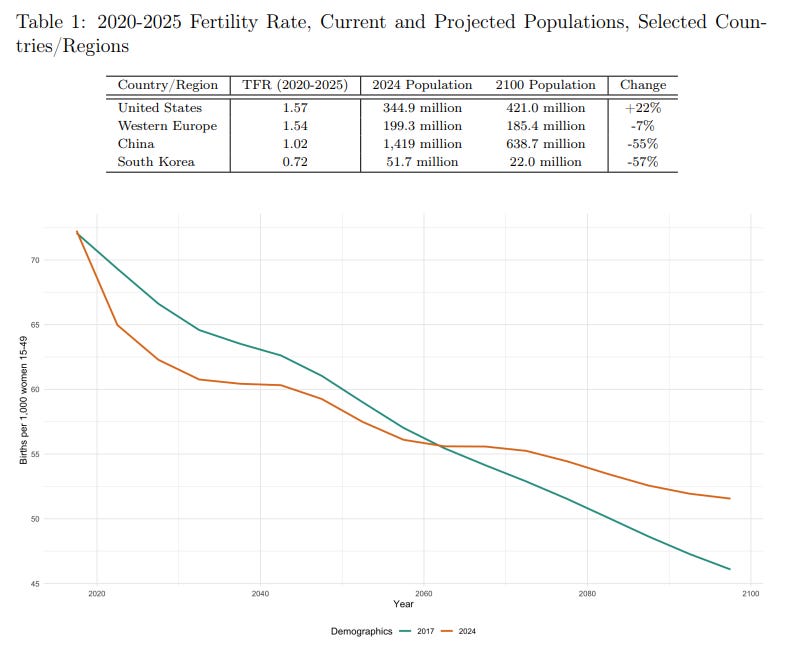
This week’s Chart comes from a recent NBER working paper by Seth Benzell, Larry Kotlikoff, and Victor Ye. The title is dry (”The Global Transition”). The finding is not, at least not to me. Demographics are quietly redrawing the map of economic power, and the UN’s latest numbers redrew it again just last year.
Kotlikoff’s team built a 17-region model of the world economy, ran it out to 2100, and did one simple experiment. They fed it the UN’s 2017 population forecast, then the 2024 one, and watched what changed. Seven years apart, same model, and the answer moved a lot. Now, it’s just a model which, as all models do, simplifies a very complex data set, but I do find the results interesting and discussion-worthy.
Let’s start with the bad news. Fewer babies means fewer workers, which means aging retirees hold more of the wealth than young savers can absorb. That’s a global savings glut. I know that’s hard to believe in our current world of global debt and deficits, but there it is.
In the model, aggregate return on capital falls from 5.9% today to under 2% by 2100. Pension math breaks down. World payroll tax rates roughly double, and the effective U.S. tax burden on income climbs from 38% to 47%.
The geopolitical punchline is sharper. Under the older 2017 numbers, China’s share of world output grew to 25.6% by 2100 and the economic baton passed from us to them. Under the 2024 numbers, China’s collapsing fertility cuts that share to 14.9%, while the U.S. rises to 14.4%. The baton stays home. Not because America got stronger, but because China got older, faster.
Then the authors add AI, and the story flips again. If automation transforms production the way many think it might, the capital glut disappears, the return on capital jumps back to 6%, and the U.S. share of world output doubles to roughly 26%, well ahead of China’s 17%.
Why does America win the AI scenario? It’s a simple idea. The U.S. has the world’s most expensive labor and the highest productivity. So, it has the most to gain from machines that replace workers, and it adopts them first. China, with cheap labor, rationally waits. By the time it catches up, the century is over.
Howeveer, one important lever swings the whole thing: immigration. Cut U.S. net migration to zero and America’s 2100 output share drops from 14.4% to 9.2%, below three fifths of China’s. The demographic edge the U.S. enjoys is largely an immigration edge.
So what do I take from this, as an investor rather than a forecaster?
Own the machines. If labor’s share of output continues to shrink while capital’s grows, then owning the productive assets, not earning a paycheck, is the ballgame for the rest of the century. Pretty much the same conclusion I landed on last week, just viewed through a different lense.
I think it’s vital to keep a sharp eye on real rates, always important, but increasingly moreso. The aging demographic story says rates will fall for decades. The AI story says they snap back to 6%. Both can’t be true, and the tension between them will be one of the most important open questions in the investing landscape over the coming years.
Demographics set the board. AI decides who plays it well.
Sources: Benzell, Kotlikoff & Ye, “The Global Transition: The Impact of Demographics and AI on Economic Power,” NBER Working Paper 35618, August 2026. UN World Population Prospects (2017 and 2024 revisions).
🚙 Interesting Drive-By’s 🚙
🤔 AI, Robots, and ROK - Shapiro’s contrarian read is that AI gains flow to the downstream users who apply it, not the compute suppliers funding it, and the U.S. lead rests on a strained grid and 30-plus-month transformer lead times while China installs one of every two industrial robots on earth.
💡 The Death of the Company - Diamandis argues AI agents dissolve the coordination costs that justify the firm, bullish for a two-person shop with AI leverage and quietly bearish for the large-cap operating-leverage story if headcount stops being a moat (treat the 100x and 90-day claims as projections).
🤔 The Robber Barons: Neither Robbers nor Barons - Henderson’s revisionist case is that the 1880s robber barons won by cutting prices and flooding output (Standard Oil cut refined-oil prices 61% as output rose 393%), the pro-concentration steel-man now aimed at the Mag 7 (verify the figures; Econlib is classical-liberal).
💰 Why Vanguard and Altruist Create a More Viable Competitor to Schwab, Fidelity - Vanguard’s $4.6 billion all-cash buy of Altruist puts custody, technology, and advisor distribution in one manufacturer’s stack, so the open architecture every RIA leans on becomes a promise rather than a structural fact (verify the price against Vanguard’s release).
👀 Gen Z Is Mistaking Sports Betting for Investing - a Betterment survey found more than half of Gen Z has redirected investing money into sports gambling and about a quarter now call betting a long-term strategy, a bull-market lesson that risk is free and the mirror image of risk-first de-risking (single-vendor survey, verify).
👋🏼 Parting Thought
Trying to stay focused on what’s most important these days…

If you have any cool articles or ideas that might be interesting for future Sunday Drive-by’s, please send them along or tweet ‘em (X ‘em?) at me.
Please note that the content in The Sunday Drive is intended for informational purposes only, and is in no way intended to be financial, legal, tax, marital, or even cooking advice. Consult your own professionals as needed. The views expressed in The Sunday Drive are mine alone, and are not necessarily the views of Investment Research Partners.
I hope you have a relaxing weekend and a great week ahead. See you next Sunday...
Your faithful financial provocateur,
-Mike
If you enjoy the Sunday Drive, I’d be honored if you’d share it with others.
If this was forwarded to you, please subscribe and join the other geniuses who are reading this newsletter.