


👋🏼 Hello friends! Let’s enjoy another Sunday Drive around the Internet.
🎶 Vibin’
Lately, I’ve been missing the music of the ‘80s, the shoulder pads, and all the HAIR, including mine! The emergence of MTV made the strength and production value of a song’s video a huge key to its success. This week, for no particular reason (😉), I’m vibin’ to Steve Winwood’s 1986 hit, Higher Love; great video, great song, great vibe, GREAT voice. Enjoy.
💭 Quote of the Week
“Great things are done by a series of small things brought together.”
— Vincent van Gogh
📈 Chart of the Week
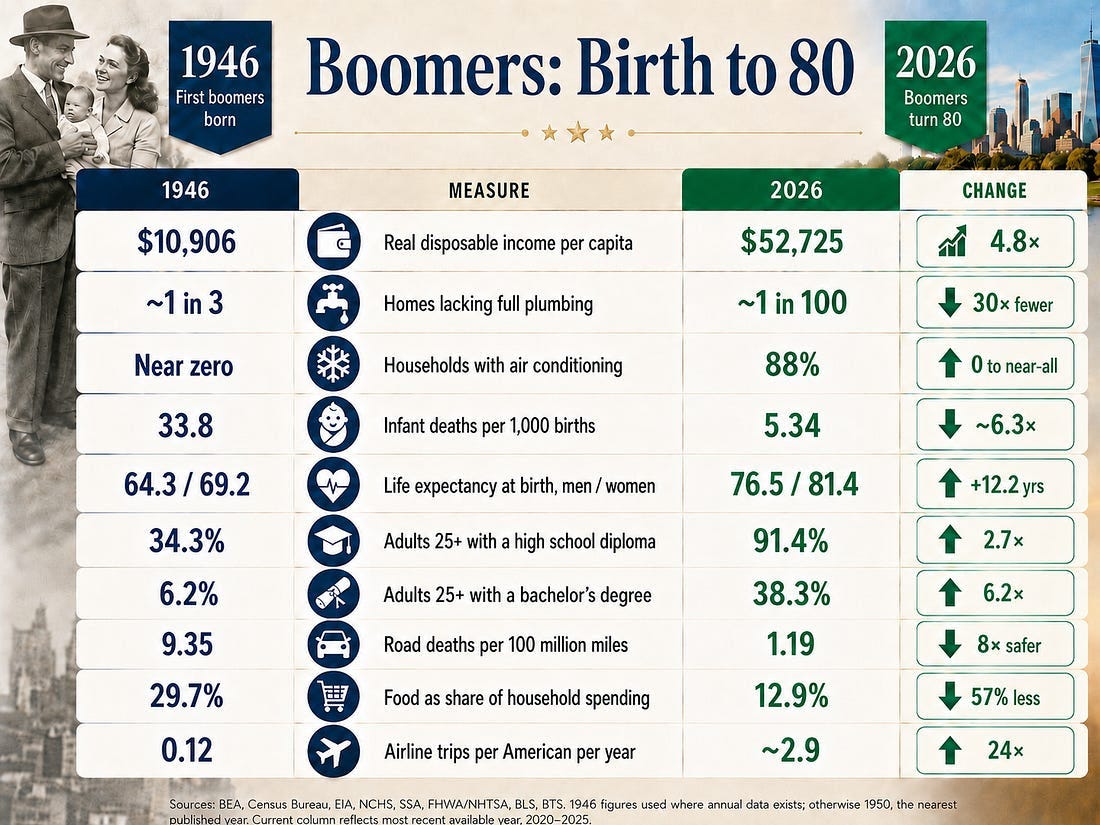
🍼 From Birth to 80, and the 80 That Follow
Most weeks, the article discussing the Chart of the Week focuses on investing or financial market related topics. But every now and again, I run across a chart or, in the case of this week, an infograph, that is really thought provoking and focused on longer-term trends.
As I reflected on it, it’s amazing just how far we’ve come in the postwar period and how our lives and society have changed. It also prodded me to continue thinking, given all the changes that appear to be coming at us in the future, about what might the next generation’s life be like? How can we prepare for it, yes, as investors but also as a society? Very Fourth Turning-esque, I admit.
A baby born in the U.S. in 1946 arrived into a country where one home in three lacked full plumbing, almost nobody had air conditioning, and a third of adults never finished high school. Roughly one newborn in thirty didn’t live to a first birthday. Real disposable income per person was under eleven thousand dollars in today’s money, and a boy could expect to see about 64.
Eighty years later that same person is turning 80 in a country that is nearly unrecognizable. Income per capita is almost five times higher. Infant mortality fell by a factor of six. Life expectancy jumped more than twelve years. We fly, on average, three times a year instead of once a decade, and food went from thirty cents on the household dollar to under thirteen. Nobody voted for this. It accumulated, quietly, one boring year of compounding at a time. That is the most underrated force in human affairs, and it is exactly why the doomsayers have been wrong for eight straight decades.
So here is the more interesting question, the one that actually matters for the babies being wheeled home from the hospital this week: what does their chart look like in 2106?
You’re right to consider the rest of this article to be speculation, because it is. But in my view, the direction feels solid enough to bet on.
Health care and longevity are the lever. The Boomer story was about not dying young. The next story is about not aging fast. If longevity research delivers even half of what its serious proponents claim, meaning we start treating aging itself as the condition rather than playing whack-a-mole with its symptoms, a child born in 2026 may come to see 100 the way we now see 80: common, unremarkable, and mostly healthy. That one change rewrites everything downstream of it.
Labor is where it gets uncomfortable. AI is doing to cognitive work roughly what the tractor did to the farm. The boomer spent a career trading hours for dollars. Their great-grandchild may find, outside of some of the trades and many service jobs, the machines are simply better at most of the hours. That is not automatically a tragedy; the farm emptied out and we did not starve, we got everything else instead. But the transition is where the pain lives, and pretending otherwise is quite foolhardy, in my opinion.
Which makes capital the quiet protagonist of the coming century. If labor’s share of the pie shrinks, then owning a slice of the machines, the land, the energy, and the ideas becomes the whole ballgame. But here is the uncomfortable part: returns to capital may compound faster than ever because labor is getting cheaper. Whoever owns the robots owns the output. How we spread that ownership, and not merely the output it throws off, is the political question of the next fifty years. Early signs of shifting political winds are starting to show up already in recent elections, and I personally believe we will see these accelerate. Again... The Fourth Turning.
Education stops being a one-time download you finish by 22 and becomes a lifelong operating system. A 100-year life with a 20-year career half-life demands three or four reinventions. The kid born today will “graduate” a dozen times, and the diploma that matters most may be the one earned at 70.
And space is the wild card I am the most intrigued by and hopeful for. For the first time, the cost curve is finally bending the right way. If we get manufacturing, mining, and eventually energy off the planet, the whole zero-sum framing of Earth’s fixed resources quietly dissolves. That is a physics problem slowly turning into an engineering problem.
So is the future of the coming generation bright or bleak? My answer to that, at least today is: bright, with an asterisk. Materially, the babies of 2026 will almost certainly live longer, healthier, wealthier, and freer than any humans who have ever drawn breath. Abundance is the base case, not the moonshot.
The asterisk is not scarcity. It is distribution and meaning. When the machines make the stuff and time itself is no longer scarce, the hard questions stop being how do we get enough and become who owns it and what are we here for. Those are better problems to have. But, they are still problems, and they are the kind that don’t solve themselves through compounding.
The Boomers spent eighty years proving the pessimists wrong about the material world. I suspect the generation in the maternity ward this morning will do the very same thing, and then spend the rest of their unusually long lives arguing about everything that’s left. Sounds about right to me.
Sources: Chart of the Week data compiled from BEA, U.S. Census Bureau, EIA, NCHS, SSA, FHWA/NHTSA, BLS, and BTS. 1946 figures used where annual data exists, otherwise 1950 or nearest published year; current column reflects most recent available year, 2020 to 2025.
🚙 Interesting Drive-By’s 🚙
📉 The Economy Is Growing. So Why Is It Losing Jobs? - labor’s share of nonfarm business output just hit a 75-year low of 52.9% even as output rose on flat hours, the cleanest macro fingerprint yet of an economy paying capital and not work, and the hard-data companion to last week’s K-shape read.
🤔 Economists Should Be Worried About Birth Rates - the fashionable “automation will cover the missing workers” comfort leans on the one paper whose own lead author (Acemoglu) elsewhere pegs AI’s total-factor-productivity gain at under 0.53%, so the demographics bill does not simply get automated away.
💰 Breaking the AUM Mold: Separating Planning From Investments - the 1% AUM fee has looked durable mainly because a 15-year bull market kept lifting the denominator, so the same drawdown that panics clients also cuts the revenue that pays to hold their hands, which is the case for pricing planning as its own product.
🤔 Who Gets Rich When Everyone Can Code - cheaper AI production does not flatten the winner-take-all curve, it just lengthens the long tail (the top 1% of app publishers already take 93% of revenue), so the value pools at the distribution and platform layer, not among the millions of new builders.
💡 The Art of Self-Promotion - in an AI-slop-saturated attention economy the maker now owns distribution too, and “self-promotion, if your product is good, is self-respect” is a useful gut-punch for any buy-side lifer who assumes good work sells itself.
🏠 FBI and Prosecutors Warn Property Owners About Deed Fraud - the paid-off home is the asset retirees check least, and forged quit-claim deeds exploit exactly that gap (the FBI logged 58,141 real-estate-fraud victims and $1.3 billion in losses over 2019-2023), a hidden risk with a nearly free fix in county deed alerts and title insurance.
👋🏼 Parting Thought
The bond market be like, “Come at me, bro.”

If you have any cool articles or ideas that might be interesting for future Sunday Drive-by’s, please send them along or tweet ‘em (X ‘em?) at me.
Please note that the content in The Sunday Drive is intended for informational purposes only, and is in no way intended to be financial, legal, tax, marital, or even cooking advice. Consult your own professionals as needed. The views expressed in The Sunday Drive are mine alone, and are not necessarily the views of Investment Research Partners.
I hope you have a relaxing weekend and a great week ahead. See you next Sunday...
Your faithful financial provocateur,
-Mike
If you enjoy the Sunday Drive, I’d be honored if you’d share it with others.
If this was forwarded to you, please subscribe and join the other geniuses who are reading this newsletter.