


👋🏼 Hello friends! Let’s enjoy another Sunday Drive around the Internet.
🎶 Vibin’
This week has been one of reunion. Two of my daughter’s teammates from the 2018 Skidmore College Equestrian Team came to visit, one from Washington D.C. and one from New York City. The Skidmore Riding Team is the most highly decorated collegiate equestrian team in the country with nine national championships, including 2018 on which all three of them competed. It has been really nice to see them all together again and enjoying Saratoga Springs. #SkidEq4Life
So, a shoutout to the two newest subscribers to the Sunday Drive for suggesting this week’s vibe (though maybe not the version they had in mind). Courtesy of Janine and Erin, I’m vibin’ to B.B. King’s live rendition of Let the Good Times Roll. Enjoy.
💭 Quote of the Week
“To improve is to change, so to be perfect is to have changed often.”
— Winston Churchill
📈 Chart of the Week
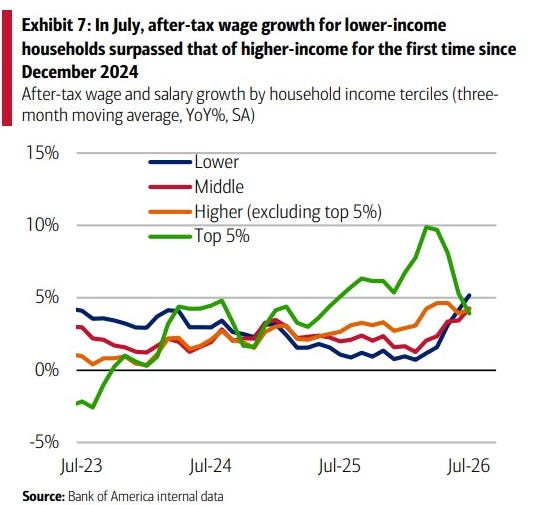
Is the Gap in the K-Shaped Economy Narrowing?
The “K-shaped economy” became shorthand for a two-track world: the top arm of the K climbing while the bottom stalls or slides. We have been living inside that letter for several years now, and most of the recent data has done nothing to challenge it. The last few weeks brought some genuinely soft prints, enough to have people whispering about a labor market cooling and possibly even a looming recession. So it would be easy to file this week away as more of the same.
This week’s chart, from the Bank of America Institute, says something else, and it is more hopeful than the headlines.
The chart splits after-tax wage growth into household income terciles. The provocative bit is the crossing: in July, wage growth for lower-income households passed higher-income households for the first time since December 2024. The green line, the top 5%, which spiked near 10% last year and has since decelerated back toward the pack. The blue line, the lower-income cohort, is curling up to meet it. The two arms of the K are bending back toward each other.
BofA sees the same compression in spending, not just wages. Lower-income consumption is growing faster; upper-income spending is slowing. When the wage data and the spending data tell the same story, I start to pay attention.
So is the economy becoming less K-shaped? Maybe. One month is not a trend, and I would not build a thesis on a single crossing. But the more interesting question is not whether it happened. It is why.
Here is the cause I think most folks are not fully appreciating: rent.
For renters, housing is almost always the single largest line in the budget. Roughly a third of American households already spend more than 30% of income on housing and utilities, and for about 16% of us, shelter alone eats more than half of what comes in. When rents are ripping higher, as they have the last several years, that line item crowds out everything else, and it crowds out the bottom of the income distribution first, because those households rent and have the least slack. That is the machinery that builds the lower arm of the K in the first place.
But now it’s flipped. Rent growth has flattened, and flat rents quietly hand money back to exactly the households that were most squeezed. The dollar that is not going to the landlord this month can go to groceries, a car repair, a small indulgence, or the electric bill. That is real wage growth by another name, and it shows up as the bottom of the K finally lifting.
None of this erases the soft labor data, and a cooling job market could widen the gap again. But for one month at least, the gap narrowed. In an economy we keep drawing as a K, that is worth noticing.
Sources: Bank of America Institute, “Has the wage growth ‘K’ closed?” and the July 2026 Institute Employment Report; Axios, “Spending narrows between lower- and higher-income Americans”; housing cost-burden figures from the Joint Center for Housing Studies, The State of the Nation’s Housing 2025.
🚙 Interesting Drive-By’s 🚙
💰 How to Get Rich in America - Scanlon’s data is the alarming part and her causal story the softer part: capital’s share of output climbed from 7% to 11.7% since 1980 while labor’s slid from 58% to 51%, and Americans 70+ now hold 32% of household net worth (up from 20% two decades ago), so the great-wealth-transfer story and the speculation-as-rational-response story turn out to be the same story read from opposite ends of the age curve.
🤔 Apple Is the King of AI and Nobody Noticed - Treat the “NVIDIA is obsolete” conclusion as provocation rather than forecast (the piece cherry-picks run-it-at-home inference and skips that training still lives in the datacenter), but the frame sharpens the capex-vs-revenue lens: if a ~$9,500 Mac Studio can run the same trillion-parameter models that need $60,000 to $75,000 of NVIDIA gear, some of the AI build-out may be pouring concrete for compute that quietly migrates to hardware you already own.
🤓 It’s Time to Complicate - Green (the passive-flows Cassandra, now launching Tier1 Alpha) makes his sharpest case yet that index ownership leaves the tape reflexive and fragile because the marginal bid answers to fund flows rather than fundamentals, so give the structural diagnosis full weight and the “here’s the fund to exploit it” conclusion the skepticism you owe any manager raising assets against his own thesis, then keep the line worth keeping regardless: the race to zero fees “confused cost with value.”
🏠 Don’t Let Inherited Vacation Homes Tear Apart Families - The family lake house feels like the safest, most sentimental asset on the balance sheet yet it is the one that quietly hands heirs an illiquid, cash-hungry liability with no governance, so Green’s fix is to put real numbers on the annual carrying cost to strip out the emotion and then pin down ownership shares, usage, and buyouts in an LLC or trust before a death forces the conversation.
💡 We Made Bell Labs Illegal - Harrison argues foundational innovation needs three things almost no US institution can still assemble (monopoly-insulated “rent” for patient capital, a concrete deployable mission, and a research-to-manufacturing “loading dock”) that antitrust and the 7-to-10-year venture cycle dismantled, with TSMC as his lone modern example, which turns the AI-capex question sharp: are today’s hyperscaler cash machines building the next transistor or just financializing the last one?
🚀 Nuclear Rockets Are Coming - The physics is sound (nuclear thermal engines run two to three times a chemical rocket’s specific impulse, cutting a Mars transit to 3 to 4 months from 6 to 9) but the 2028-testing, 2030-deployment dates are a professional optimist’s calendar with no clean public-market vehicle to own the thesis, so read it as an abundance-of-progress piece.
👋🏼 Parting Thought
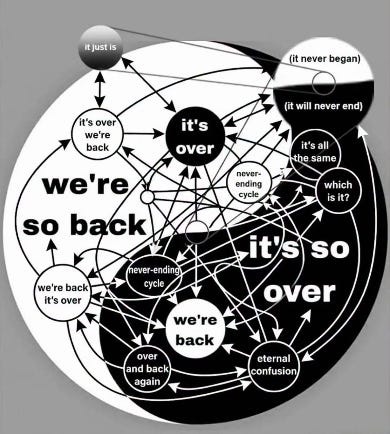
How the economy and financial markets feel these days…
If you have any cool articles or ideas that might be interesting for future Sunday Drive-by’s, please send them along or tweet ‘em (X ‘em?) at me.
Please note that the content in The Sunday Drive is intended for informational purposes only, and is in no way intended to be financial, legal, tax, marital, or even cooking advice. Consult your own professionals as needed. The views expressed in The Sunday Drive are mine alone, and are not necessarily the views of Investment Research Partners.
I hope you have a relaxing weekend and a great week ahead. See you next Sunday...
Your faithful financial provocateur,
-Mike
If you enjoy the Sunday Drive, I’d be honored if you’d share it with others.
If this was forwarded to you, please subscribe and join the other geniuses who are reading this newsletter.