


👋🏼 Hello friends! Let’s enjoy another Sunday Drive around the Internet.
🎶 Vibin’
My wife and I were recently at a local restaurant which features live music. Playing that evening was a very talented local duo, both singing and playing acoustic guitars. One song they played seemed to fit the mood this week. No theme, just relaxing to a classic hit by Willie Nelson that sets the tone for the Dog Days of Summer. I hope you enjoy the beautiful Angel Flying Too Close to the Ground.
💭 Quote of the Week
“I attribute my success to this: I never gave or took an excuse.”
— Florence Nightingale
📈 Charts of the Week
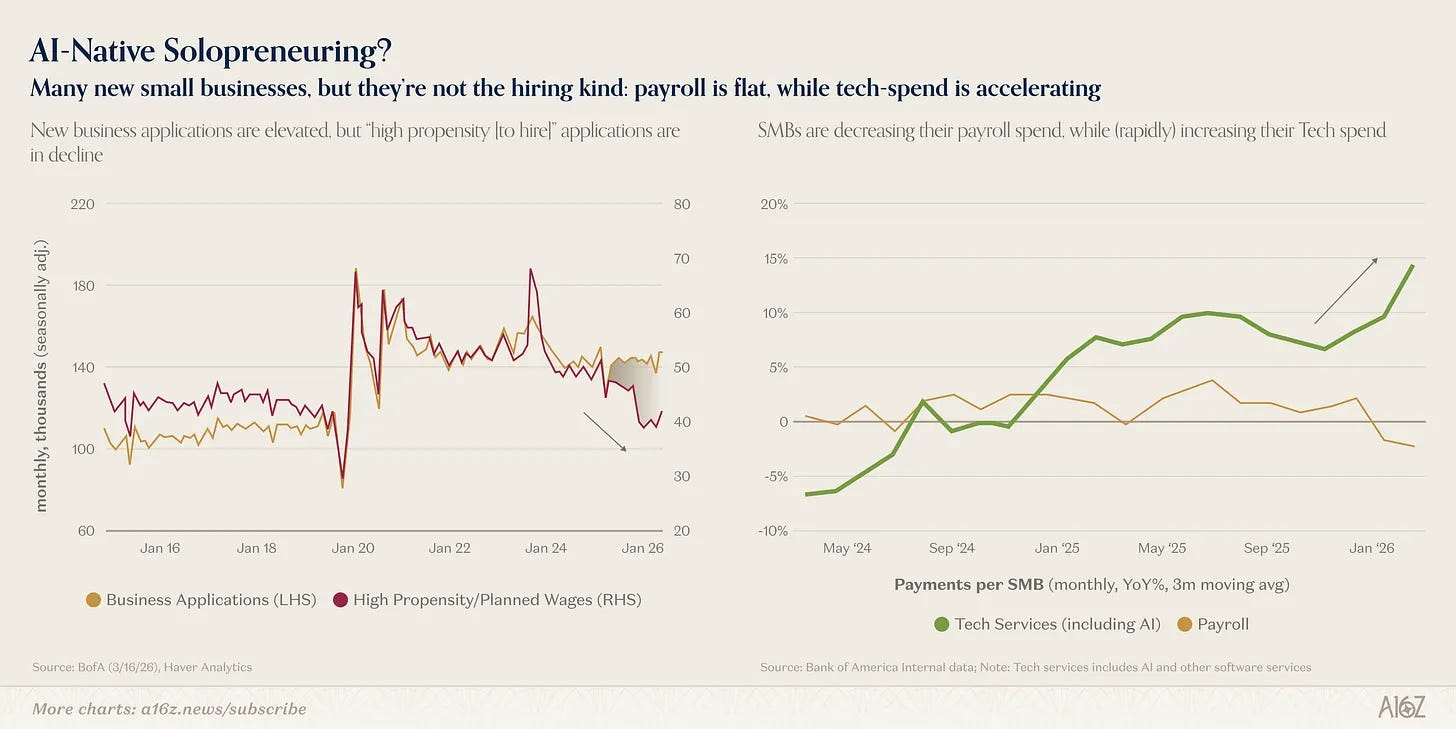
🪜 The First Rung Is Missing
Two charts this week, and together they tell a story about our younger generations.
The first chart shows that new business applications are still strong; Americans keep forming companies at a healthy clip. But look at the red line: applications from businesses with a “high propensity to hire” are rolling over. The right-hand panel is instructive. Across millions of small businesses, payroll spend has gone flat-to-negative while spending on tech services (AI very much included) is accelerating toward 15% year-over-year. New firms are being born. They’re just not being born hungry for employees.
That’s a quiet revolution, and it lands hardest on the young. The entry-level job, the mailroom, the analyst seat, the “we’ll train you” hire, has always been the bottom rung of the career ladder. It’s also, in large part, exactly the work a capable model now does for the price of a subscription. When a two-person startup can rent the output of a junior employee instead of hiring one, the rung disappears. You can’t climb a ladder that’s missing its first step.
Now the college question, which everyone loves to argue and nobody wants to answer honestly. The New York Fed still pegs the return on a bachelor’s degree around 12.5%, so on average the diploma still pays. But averages hide everything interesting. Engineering grads clear roughly $949,000 in extra lifetime earnings; nearly a quarter of programs post negative returns. Small wonder confidence in higher education has slid to 38% from 57% a decade ago, and that 44% of graduates say their own degree didn’t pay off. When 64% say they wouldn’t take the loan again, that isn’t anti-intellectualism. It’s a market repricing a product whose implied guarantee, the good first job, just got automated.
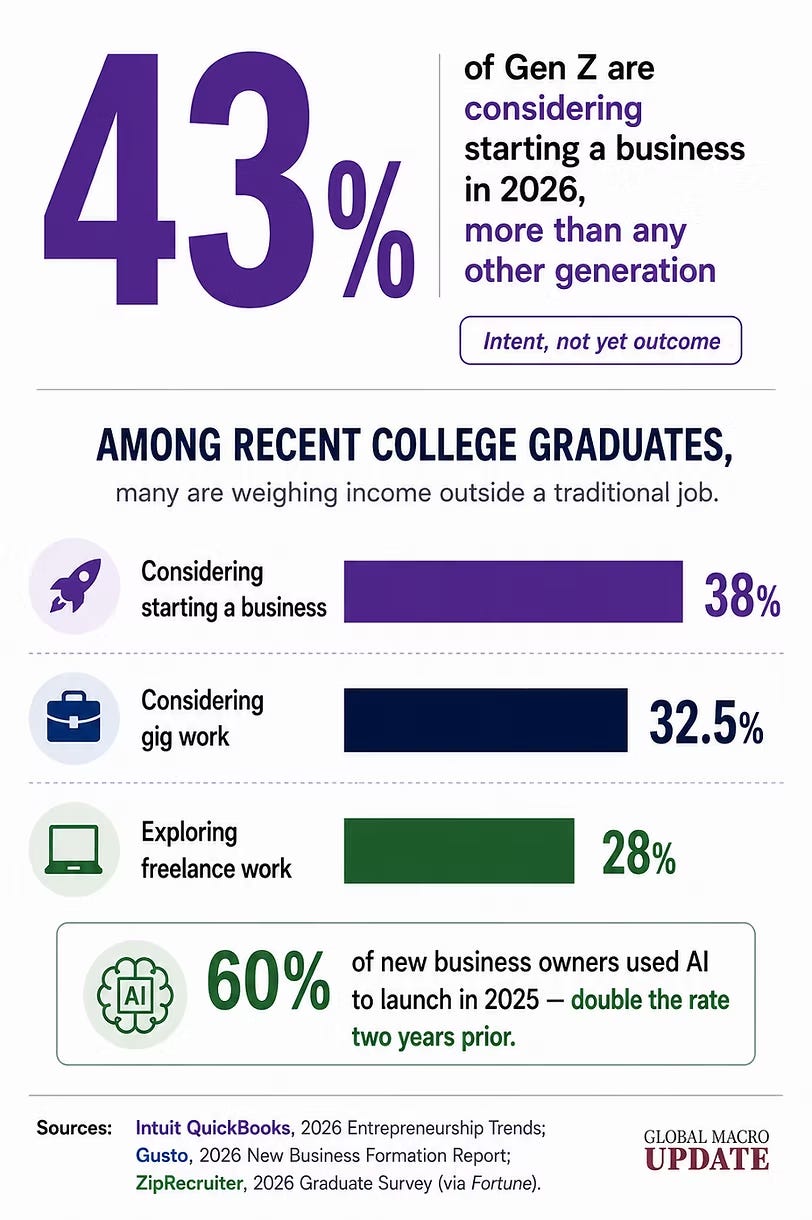
Younger folks are responding rationally. In one survey, 39% ranked trade school as the best return on investment, against just 25% for a four-year degree. A welder’s torch, a nursing license, an HVAC van: none of that gets vacuumed up by a chatbot, and none of it arrives with $30,000 of debt attached. Meanwhile, the second chart shows 43% of Gen Z considering starting a business in 2026, more than any generation before them, with another third eyeing gig or freelance work. Call it intent rather than outcome (most won’t follow through), but the direction is unmistakable. If the ladder won’t hire you, you build your own.
Here’s the twist that ties both charts together: AI is what makes the exit ramp passable. Sixty percent of new business owners used AI to launch in 2025, double the rate just two years earlier. The same tool that ate the entry-level job is also the co-founder, the marketing department, and the back office for a twenty-three-year-old with a laptop and no employees. The technology closing the front door is quietly holding the side door open.
So which is it: crisis or renaissance? Maybe both, and the answer turns on whether a young person can get to the tools before the tools get to their first paycheck. The generation that learns to direct AI will do just fine. The one waiting around to be hired and trained may be waiting a long while. That’s the provocation worth sitting with, and for those of us thinking about who funds the next few decades of retirements, it’s not a small one. 🤷🏼♂️
Sources: a16z, Charts of the Week | Mauldin Economics, Is College Worth It? | Credible, Is College Worth It? Survey
🚙 Interesting Drive-By’s 🚙
👀 A Bird’s Eye View for Data Center Site Selection - The risk hiding inside the AI capex number is that it’s a paper figure, since satellite timelapse shows hyperscale construction lagging the announcements and permits investors mark to, while a Harvard Kennedy School draft finds the power-bill costs leaking to non-host counties even as the jobs and tax revenue stay local.
💡 The End of the Age of Heroes - OpenAI’s claim that its “Astra” model cracked ten open problems in math signals the end of the lone-genius era, but Smith’s sharper point is economic: the entire US academic-math payroll is only $4 to 5 billion (about what America spends on Halloween candy), a rounding error the system will keep funding for “professional math-understanders.”
📉 Foundations: Market Structure & What The Heck Just Happened - Burry’s risk-first read (paywalled past the setup) is that the S&P 500’s 12.09% annualized real return since 2011 rests on a dividend contribution of just 1.76%, a 1st-percentile reading across 145 years, because buybacks and RSU withholding have replaced the only non-reversible leg of shareholder return and left the whole bull case leaning on earnings quality.
🤔 A Global Weighing Machine - Harrison argues Graham’s comfort blanket (short-run voting machine, long-run weighing machine) is breaking because reflexivity and social-media speed now let the votes reach in and edit the asset itself, with SVB’s $142 billion two-day run (81% of the balance sheet) as proof the scale never got a say.
💰 Capital Allocation Is Dead - The risk Harrison names is that the sum-of-the-parts machine a generation trained on has quietly stopped working (he modeled Figma at $200M ARR and got mocked for overshooting, then it blew past his number), so every allocator is now really betting one of four worldviews (quality, narrative, leverage, or time) rather than a spreadsheet.
🚀 The next frontier is under your feet - Read this downside-free “subterra” survey (Fervo geothermal selling power to Google, Quaise melting granite with millimeter waves, The Boring Co. pitched as a possible next trillion-dollar company) as theme and voice rather than data, since it’s a promoter’s list of pre-revenue names selling a market that doesn’t exist yet (Kola took 19 years to reach 7 miles).
🎯 Inherited Assets and Divorce: Avoiding Costly Mistakes - The hidden-risk point advisors miss is that an inheritance stops being “separate” the moment it’s touched, since dropping a bequest into a joint account or spending marital cash on an inherited house lets commingling quietly reclassify it as marital property a divorce court can divide, so only sole titling, segregated records, and a pre- or postnuptial agreement preserve the claim.
👋🏼 Parting Thought
If you have any cool articles or ideas that might be interesting for future Sunday Drive-by’s, please send them along or tweet ‘em (X ‘em?) at me.
Please note that the content in The Sunday Drive is intended for informational purposes only, and is in no way intended to be financial, legal, tax, marital, or even cooking advice. Consult your own professionals as needed. The views expressed in The Sunday Drive are mine alone, and are not necessarily the views of Investment Research Partners.
I hope you have a relaxing weekend and a great week ahead. See you next Sunday...
Your faithful financial provocateur,
-Mike
If you enjoy the Sunday Drive, I’d be honored if you’d share it with others.
If this was forwarded to you, please subscribe and join the other geniuses who are reading this newsletter.