


👋🏼 Hello friends! Let’s enjoy another Sunday Drive around the Internet.
🎶 Vibin’
While most recent headlines are focused on Iran, the Fed, mid-term elections, and all manner of. mainstream concerns, I’m thinking about the recent implosion of Leopold Aschenbrenner’s hedge fund, Situational Awareness, its impact on the equity markets during the month of July, and the potential knock-on effects it may or may not have.
So, the 25 year old Wunderkind with no investment experience, but an allegedly insightful 2024 essay on AI investing, grew his hedge fund from $225mm to $45 BILLION in less than two years (Source: Bloomberg). Then it blew up. 💥💣
More on this topic below in the Chart of the Week section, but this week I’m vibin’ to Iggy Pop’s Real Wild Child, ‘cuz…. kids these days. 🤷🏼♂️
💭 Quote of the Week
“Parents should leave books lying around marked ‘forbidden’ if they want their children to read.”
— Doris Lessing
📈 Chart of the Week
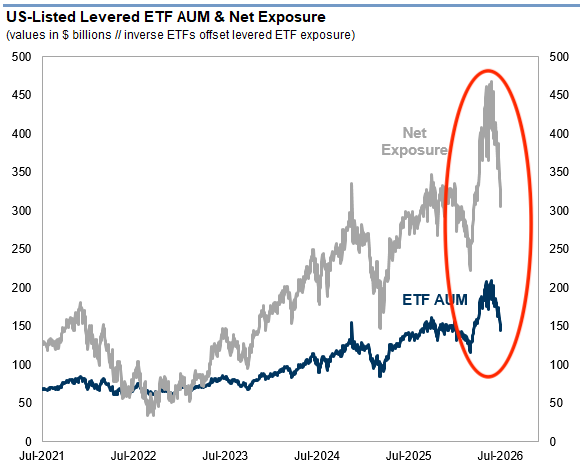
💥 Situational Awareness: Oh, The Irony!
This week’s Chart is a vivid illustration of the power of leverage, in both directions. George Soros’ term “reflexivity“ comes to mind when one looks at the forced selling that occurred in July in many of the high flyers that had done so well in recent years... and it may have been catalyzed by a single hedge fund.
A 25-year-old with no trading experience took a fund from roughly $225 million at launch in 2024 to as much as $45 billion by early July. Through June 30 it was up 439%. In a matter of days near the end of July, the whole public book was gone, sold in a single pre-market block to Ken Griffin’s Citadel at a discount.
That’s Leopold Aschenbrenner’s Situational Awareness, and the cause of death matters more than the headline. This is a textbook example of the perils of excess leverage and a lack of risk control in portfolio construction.
The investment thesis was defensible. Long the picks-and-shovels of AI (SK Hynix, Micron, CoreWeave, Nebius, SanDisk), short the software names he figured AI agents would hollow out (Adobe). Reasonable people own some version of that trade. Plenty do.
The 4x is what turned a rough month into a liquidation.
Here are the mechanics, in plain English.
When you borrow three dollars for every one of your own, a 20-25% drop in your book doesn’t dent your equity, it erases it. At that point your prime broker stops asking politely.
Goldman, JPMorgan, and Bank of America issued margin calls, and when a call can’t be met, the broker sells your positions for you, at whatever price clears, right now. Leopold’s longs were off 35% or more on the month while the Adobe short went against him at the same time.
Squeezed on both sides, with borrowed money magnifying every tick, you don’t get to wait for the thesis to play out.
The part that should stick with you: six days before Citadel took the book, Aschenbrenner told his investors that July’s selloff offered “some of the most attractive opportunities since early 2025” and asked them to wire fresh capital by August 1. He may even have been proven right in time. It didn’t matter. The money never showed, and the forced de-leveraging began.
Keynes had it right a century ago. The market can stay irrational longer than you can stay solvent. Solvency is the whole game. Being right about AI in 2030 is worth precisely nothing if an unmet margin call liquidates you in week three of the drawdown.
Now we return to this week’s Chart, because this is where it stops being about one cocky kid and starts being about the equity market in general.
The Chart shows assets and net exposure of US-listed leveraged ETFs. Asset levels recently touched a record near $200 billion, up about 55% in a matter of months, and net exposure ran past $450 billion. Roughly 85% of it is held across the general AI investing sector. The same trade Aschenbrenner ran, wrapped in a ticker any investor can buy.
Many of these products carry Situational Awareness’s fatal reflex written into the prospectus. A 2x or 3x fund has to rebalance every single day to hold its target exposure. When the underlying rises, it buys more. When it falls, it sells. By prospectus, it is contractually required to sell into weakness, the same forced selling a margin call produces, except automated and running across millions of accounts at once. Daily rebalancing flows hit a record $50 billion this year, quadruple where they started 2026, and now amount to something like 1.6% of all S&P 500 futures volume. On a down day, that’s a wall of mechanical selling that arrives exactly when the tape is already soft.
One fund blowing up is a story. A structural bid that flips to a structural offer the moment stocks fall is a market feature, and it’s a lot bigger than $45 billion.
So here are my two (unlevered) cents. Leverage is effectively a promise to sell at the worst possible moment. It takes a temporary loss, the kind a patient investor rides out, and turns it into a permanent one, because you no longer control the timing of your exit. The broker does. Or the fund’s rebalancing rule does. You’re a passenger.
When an investor is approaching retirement, or already there, the order in which their losses arrive matters more than their magnitude. While a risk-management first approach to investing is much less thrilling than 439%, it also leaves an investor still standing in August.
The irony writes itself. The Wunderkind named the fund, and the viral essay behind it, “Situational Awareness.” The one thing 4x leverage guarantees is that you lose exactly that, right when you need it most, because at the bottom you’re not the one driving anymore.
So if you’re levered up, buckle up. It’s a long drive, and the road’s wet.
Sources: CNBC: Situational Awareness fire sale · CNBC: why the fund imploded · CNBC: forced to unwind all public positions · SpotGamma: Anatomy of a Margin Call · Benzinga: Leveraged ETF rebalancing hits $50 billion · ETF.com: Leveraged ETFs in 2026
🚙 Interesting Drive-By’s 🚙
🤔 Warsh’s Challenges, Financial Regulation - John Cochrane and Amit Seru argue every crisis is really a bank run, so Warsh’s Fed should regulate run-prone short-term liabilities instead of piling more asset-risk rules on top of Dodd-Frank.
💰 Philanthropy’s Other Third Wave - Craig Shapiro argues the best mission-driven company folds Carnegie’s make-a-fortune-then-repair-it model into a single ledger, though he concedes the thesis lives or dies on telling real mission from purpose-washing (and he’s a VC talking his own book).
💡 Building Worlds That Train Robots - Fei-Fei Li’s World Labs claims robots can learn complex manipulation with zero real-world data by turning one physical task into thousands of simulated variations, but it’s an a16z-published, portfolio-adjacent bet against a sim-to-real gap that has humbled robotics for decades.
🤔 The Project of Software is Complete - Freddie deBoer’s contrarian bet is that the era of genuinely new software categories is over, since LLMs only churn out redundant bits while the prizes we actually want (cancer, fusion, longevity) live in the world of atoms code can’t touch.
🚀 The Rational Optimist’s Guide to the Galaxy - A field guide to ~30 private space firms riding launch costs from $54,500/kg on the Shuttle toward a hoped-for sub-$100 on Starship, though half of SpaceX’s $2T valuation rests on orbital data centers that won’t scale until the 2030s.
📉 Big Trouble for Big Tech, Part II - Atlas Analytics finds the overvaluation everyone pins on the Mag 7 is now broad-based (even small caps are rich), so spreading a retiree across sectors buys less protection than the label promises.
👀 First ‘space mirror’ satellite gets green light to deliver sunlight - The FCC licensed Reflect Orbital’s demo mirror, but its planned 50,000-satellite constellation could brighten night skies 200-300% and enclose a shared public good, the dark sky, for private gain.
👋🏼 Parting Thought
If you have any cool articles or ideas that might be interesting for future Sunday Drive-by’s, please send them along or tweet ‘em (X ‘em?) at me.
Please note that the content in The Sunday Drive is intended for informational purposes only, and is in no way intended to be financial, legal, tax, marital, or even cooking advice. Consult your own professionals as needed. The views expressed in The Sunday Drive are mine alone, and are not necessarily the views of Investment Research Partners.
I hope you have a relaxing weekend and a great week ahead. See you next Sunday...
Your faithful financial provocateur,
-Mike
If you enjoy the Sunday Drive, I’d be honored if you’d share it with others.
If this was forwarded to you, please subscribe and join the other geniuses who are reading this newsletter.