


👋🏼 Hello friends! This weekend, my wife and I are celebrating another marital trip around the sun. Cheers to 34 years! 🥂❤️
Celebrate with us, and enjoy another Sunday Drive around the Internet.
🎶 Vibin’
Over the last few weeks, and especially this week it seems, a lot of things started to matter: interest rates mattered, the conflict in Iran mattered, the conflict in Ukraine mattered, runaway AI capex and strained free cash flow mattered.
Just a few weeks ago, the market didn’t seem to be bothered by much and nothing seemed to matter. So as the summer doldrums approach, I’m vibin’ to Queen’s epic hit from 1975, Bohemian Rhapsody.
Nothing really matters, anyone can see. Nothing really matters. Nothing really matters to me…
💭 Quote of the Week
“Service to others is the rent you pay for your room here on earth.”
— Muhammad Ali
📈 Chart of the Week
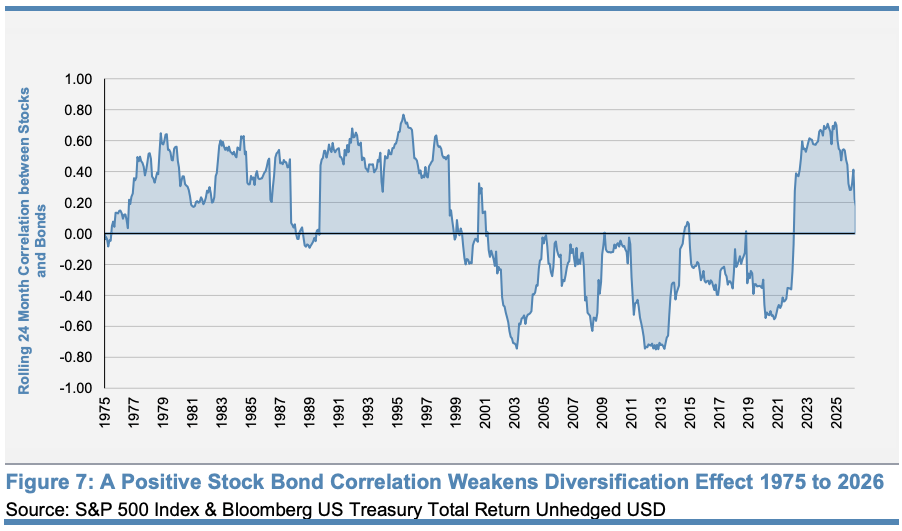
When Bonds Stop Helping
The case for a 60/40 stock and bond portfolio largely rests on one assumption: when stocks fall, bonds rise and cushion the blow. This week’s Chart shows how conditional that assumption really is. It shows the rolling 24-month correlation between stocks and bonds going back to 1975. Above zero, the two move together. Below zero, they offset each other, which is the behavior a classic 60/40 portfolio is counting on.
Notice how the sign periodically flips. From 1975 through the late 1990s it was mostly positive. Around 2001 it went negative and stayed there for two decades, the era that seemingly built the 60/40’s reputation, with bonds rallying while equities fell in 2000-02, in 2008, and in 2020. Since 2022 it has snapped back to positive.
It’s tempting to explain this with the level of inflation: high inflation in the 1970s and 80s, low inflation after. That story doesn’t really hold. Inflation fell steadily through the entire 1990s, from 5.4% in 1990 to 1.6% by 1998, and the correlation stayed positive the whole time. The level of inflation is not the switch.
What flips the sign is the relationship between inflation and growth, which essentially comes down to whether the economy is being driven by supply shocks or demand shocks.
When inflation and growth move in opposite directions, a supply-shock world, an inflation scare means higher yields and a weaker growth outlook at the same time: “stagflation”. Bonds fall, stocks fall, and the Fed is tightening into the weakness. Bonds behave like a bet on inflation, and they move with stocks. That described the 1970s and early 80s.
It also described the 1990s, because the market’s operative fear was overheating and Fed tightening, not recession. In 1994, Greenspan doubled the funds rate from 3% to 6% and the bond market was crushed while stocks went nowhere. Good news on growth was bad news for bonds. The same force moved both markets.
When inflation and growth move together, a demand-shock world, a recession brings disinflation and rate cuts. Bonds rally when stocks are falling. They become a hedge against deflation rather than a bet on inflation. That was the world from 2001 to 2021, and it’s what made 60/40 feel safe. The regime break wasn’t lower inflation. It was inflation turning pro-cyclical, once the fear of recession replaced the fear of overheating.
Academic work lines up with what we see in the Chart. John Campbell and his co-authors found that the correlation between inflation and the output gap was negative from roughly 1979 to 2001, then turned positive, and the stock-bond correlation changed sign right alongside it.
2022 showed what the supply-shock world costs. The S&P 500 returned -18.11% on a total-return basis. The Bloomberg US Aggregate, the core bond benchmark, fell 13.01%, its worst year in the history of the index. The safe half of the portfolio cushioned nothing. A 60/40 investor was hit on both sides at once.
The right edge of the chart is what matters for allocation decisions now. The correlation has been positive since 2022. If inflation stays sticky and volatile, a reasonable expectation given fiscal deficits, conflict in the Middle East, and tariff uncertainty, the negative correlation that made 60/40 feel safe may not return for years.
The concern for investors is concrete. Most portfolios still seek to de-risk the way they did in 1995: sell stocks, buy bonds. If bonds and stocks are moving together, that trade buys far less protection than it used to, and it often realizes a tax bill on the way out.
There are other tools that can be added to the equation. For example, one might cushion their portfolio’s downside with equity options, keeping the stock exposure they want while limiting the loss that many investors, particularly those in or nearing retirement, can’t afford. It has a cost. Protection always does. But it holds up even when both halves of the traditional portfolio move together, which is the environment the Chart shows we are in.
The 60/40 still works as a starting point. Its protection depends on a correlation that has now changed its sign, and that is worth considering before the next drawdown, not after.
Sources: S&P Dow Jones Indices (S&P 500 2022 total return -18.11%); Bloomberg US Aggregate Bond Index (2022 total return -13.01%); U.S. Bureau of Labor Statistics CPI data (1990-1998); Campbell, Pflueger & Viceira, “Bond-Stock Comovements,” and Campbell, Sunderam & Viceira, “Inflation Bets or Deflation Hedges?”
🚙 Interesting Drive-By’s 🚙
🤔 Finance and the Economy - Arnold Kling throws out “aggregate demand” as circular dogma (a recession happens because demand fell, and we know demand fell because there was a recession) and pins downturns on the financial sector instead, where intermediaries fund long-term risky assets with short-term riskless deposits, a structure that snaps under stress and drags the real economy down with it. His closing worry is the one worth stealing: AI companies with no free cash flow now carry hundred-billion-dollar valuations from venture capitalists, stock investors, and bond buyers alike, so if something breaks, the hit lands first on financial intermediation and then on everything it was funding.
🤔 Capital Allocation Is Dead - Kyle Harrison argues the analysis-first, sum-of-the-parts machine a generation trained on has quietly stopped working, because its core move is extrapolation and with the best assets extrapolation is always wrong on the low side (he modeled Figma at $200M ARR by 2022, got laughed at for overshooting, then watched it blow past even that). His reframe is that every allocator now aggregates around one of four worldviews rather than a spreadsheet, quality, narrative, leverage, or time, a sharp counterweight to the pure risk-first AI-capex takes since he’s a believer who still flags where opportunity falls off into hype.
💡 Networking in Life’s Second Half: What’s Different - Bill McGuire reframes second-act networking as contributing to a community rather than collecting contacts, with the payoff coming from relationships compounded over years instead of a stack of fresh business cards. The line worth stealing is that the hard part is just deciding to walk through the door and consistency beats hunting for the perfect event, a useful counter for any retiree who’s been told their social world has to shrink.
👀 First ‘Space Mirror’ Satellite Gets Green Light to Deliver Sunlight - The FCC just licensed Reflect Orbital’s single demonstration mirror, a 60-foot thin film that beams sunlight to 5-6 km ground zones, but the stated plan is a 50,000-satellite constellation by 2035 that astronomers warn could raise global night-sky brightness 200-300% and render ground-based telescopes obsolete. The honest frame is a private firm monetizing a shared public good, the dark sky, with the externality landing on everyone else, a tragedy of the commons wearing a 24/7 solar-power pitch.
🚀 The Next Frontier Is Under Your Feet - Stephen McBride’s unabashed bull survey argues “subterra” is the next frontier now that fracking-era steerable drills, high-pressure pumps, and fiber-optic rock sensing turned digging from a luck business into an engineering one, touring enhanced geothermal (Fervo selling power to Google), Pipedream’s underground delivery pipes, and boreholes for burying nuclear waste and reactors. Treat it as theme and voice rather than data, since it’s a promoter’s list that’s almost all pre-revenue (Kola only reached 7 miles in 19 years), so the real lens is single-point-of-execution risk on companies selling a market that doesn’t yet exist.
😡 How the CFP Board Sold Out the Public & the Profession - Allan Roth walks through how the CFP Board quietly converted in early 2023 from a 501(c)(3) public charity into a 501(c)(6) trade group, dropping “benefit the public” from its mission while over 9,000 CFPs who show up clean on LetsMakeAPlan.org actually carry a BrokerCheck disclosure (up from 6,300 in 2019) and nearly 1,000 have criminal disclosures (up from 140 in 2019). For anyone selling retirees a tax-efficient alternative to the double-dipped 5.29%-fee annuity the author opens with, the takeaway is that the credential now does the marketing rather than the vetting, so the fiduciary gut-check still falls on the advisor and the client.
👋🏼 Parting Thought

If you have any cool articles or ideas that might be interesting for future Sunday Drive-by’s, please send them along or tweet ‘em (X ‘em?) at me.
Please note that the content in The Sunday Drive is intended for informational purposes only, and is in no way intended to be financial, legal, tax, marital, or even cooking advice. Consult your own professionals as needed. The views expressed in The Sunday Drive are mine alone, and are not necessarily the views of Investment Research Partners.
I hope you have a relaxing weekend and a great week ahead. See you next Sunday...
Your faithful financial provocateur,
-Mike
If you enjoy the Sunday Drive, I’d be honored if you’d share it with others.
If this was forwarded to you, please subscribe and join the other geniuses who are reading this newsletter.