


👋🏼 Hello friends! Let’s enjoy another Sunday Drive around the Internet.
🎶 Vibin’
It’s still early on in Q2 earnings season but we’ve already seen a good bit of financial violence, particularly in semiconductor stocks. So this week, I’m vibin’ to Right Back Where To Where We Started from the classic 1977 sports movie, Slapshot. Let’s put on the foil and get ready for next week.
💭 Quote of the Week
“If you have economic security and people who love you unconditionally, you have an obligation to speak your mind.”
— Sam Harris
📈 Chart of the Week
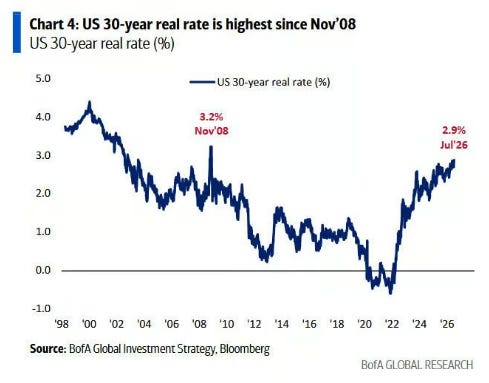
The Rate That Prices Everything
The 30-year real Treasury yield is the price of patient money. It’s what you earn, after inflation, for handing capital to Uncle Sam for three decades and asking no favors in return. Nearly every other asset gets priced off it, or its 10-year cousin, whether investors admit it or not.
For most of the 2010s that price sat near zero, and for a stretch it went negative. Free money, in real terms. That’s the soil everything seemed to grow in: private equity, venture, long-duration tech, zombie companies kept alive on cheap refinancing, houses bid to the sky. When the risk-free real rate is zero, investors pay up for distant cash flows. The alternative pays nothing.
At 2.9%, the alternative pays something again. And that quietly rewrites the math for every risk asset on the board.
Start with stocks. The case for paying a rich multiple for earnings rests on a low discount rate. Raise the real rate and the present value of future profits falls, and it falls hardest for the companies whose earnings live furthest out. Growth stocks are typically long-duration assets. In theory they take the biggest hit here. The equity risk premium, the extra you’re paid for owning stocks instead of that safe 2.9%, has thinned to a sliver.
In theory, gold should be the other casualty. It throws off no cash, so a higher real rate is pure opportunity cost, the classic headwind. Except gold has ripped anyway. That tells us the market is voting for the second story in this week’s Chart, the one about term premium and a debt load nobody wants to fund cheaply. When gold climbs into rising real rates, it’s likely pricing a cheaper dollar down the road, not deflation.
Real estate feels it straight on. Cap rates track real yields, so higher yields mean lower building values and refinancings that no longer pencil out. Commercial property is still grinding through exactly that repricing.
Here’s the part that should keep us honest. Real rates are the highest in 17 years, and risk assets, by and large, seem to be behaving like it doesn’t matter. Either growth is genuinely about to accelerate, which would justify the shrug, or investors have simply gotten comfortable ignoring the denominator.
Many of us have seen what happens when the denominator stops being ignored. It tends to happen all at once. I’m not making a call here, I’m just doing what I’m usually trying to do: looking for things to worry about that the financial markets appear to not be worried about.
Sources: BofA Global Investment Strategy and Bloomberg.
🚙 Interesting Drive-By’s 🚙
📉 Leveraged Stock ETFs Are as Stable as a Row of Dominoes - Aaron Brown walks through the $150 billion pile of 450-plus leveraged single-stock ETFs built since 2022, where volatility drag quietly mauls the retail buyers but the real danger sits upstream with the yield-hungry funds that sold the structuring banks their crash protection, the same setup that vaporized the monolines in 2008. Each fund is individually 2x-compliant, yet they share one fuse in the AI-capex trade and all rebalance into the same closing auction on the same afternoon, so they’re hedged individually and fused collectively.
💸 The Second Derivative: Why No One Understands the AI Boom - Groundbreaker argues the AI build-out is being financed like 2008 rather than 2000, a stack of take-or-pay leases, GPU-collateralized loans, and asset-backed notes sold to insurers that seizes up rather than gently de-rating the way patient dot-com equity did. Everyone watches the level and the growth rate while nobody watches the second derivative, so the machine breaks the moment demand simply stops accelerating against all the fixed supply the boom just poured.
🏠 The Missing Middle: Where Do We Live Between 55 and 80? - Chip Conley flags a demographic mismatch the senior-living industry quietly baked in, communities designed for healthy mid-60s residents now filling up with people who move in at 83 to 85 after a health event, leaving roughly 25 years of active, solvent, community-hungry adults with nowhere purpose-built to go. His reframe is that America has a belonging shortage sitting on top of millions of empty bedrooms, so the retirement question isn’t only whether you have enough money but where and how you’ll actually live.
🤔 Are Index Funds Communist? Part III - Be Water makes the deliberately provocative case that market-cap weighting is a rich-get-richer allocation rule, where every new passive dollar flows disproportionately to whatever already has the largest weight, so the index doesn’t measure the market so much as it programs where capital is allowed to go. It’s more polemic than proof, but the underlying mechanism is real and it’s the same one that makes today’s top-heavy S&P a hidden-risk story rather than a diversification story.
🤓 Ridley: Why Our Public Sector Is So Unproductive - Matt Ridley pairs Jevons (everything AI touches, from transistors to tokens, gets radically cheaper and we promptly use vastly more of it) against Baumol (sectors with stagnant efficiency like healthcare, education, and government just get more expensive as they compete for the same labor). His unnerving data point is that UK public-sector productivity has shown zero gain since 1997 despite the entire internet-and-mobile era, and his bet is that bureaucracy simply expands to swallow whatever efficiency AI hands it.
👀 Are Prediction Markets Doomed to Fail? - Contrary Research lays out how “prediction market” is largely a regulatory costume for sports gambling, with sports contracts over 90% of Kalshi’s volume and combined Kalshi/Polymarket monthly volume leaping from under $5 billion last September to $24 billion by April, rivaling US sportsbook handle. Because they charge thin exchange-style fees instead of a 10% hold, the real engine isn’t the bets at all but the interest earned on idle customer cash, worth knowing before anyone mistakes these for neutral forecasting tools.
👋🏼 Parting Thought
In light of the recent incident at Yellowstone National Park where an elderly grandpa got ragdolled by an elderly bison, I offer this PSA:

If you have any cool articles or ideas that might be interesting for future Sunday Drive-by’s, please send them along or tweet ‘em (X ‘em?) at me.
Please note that the content in The Sunday Drive is intended for informational purposes only, and is in no way intended to be financial, legal, tax, marital, or even cooking advice. Consult your own professionals as needed. The views expressed in The Sunday Drive are mine alone, and are not necessarily the views of Investment Research Partners.
I hope you have a relaxing weekend and a great week ahead. See you next Sunday...
Your faithful financial provocateur,
-Mike
If you enjoy the Sunday Drive, I’d be honored if you’d share it with others.
If this was forwarded to you, please subscribe and join the other geniuses who are reading this newsletter.