


👋🏼 Hello friends! Let’s enjoy another Sunday Drive around the Internet.
🎶 Vibin’
Those of you who’ve followed the Sunday Drive for a while know that I’m a sucker for mashup videos and creative covers.
There’s no particular tie to a theme this week - well maybe a VERY loose tie to the SpaceX IPO.
This week, I’m vibin’ to Dutch opera singer Maria Fiselier’s cover of Eminem’s Lose Yourself. My apologies for some NSFW language. But hey, it’s an Eminem song. 🤷🏼♂️
💭 Quote of the Week
“The tallest trees are built from the strongest roots.”
— Kyle Harrison
📈 Chart of the Week
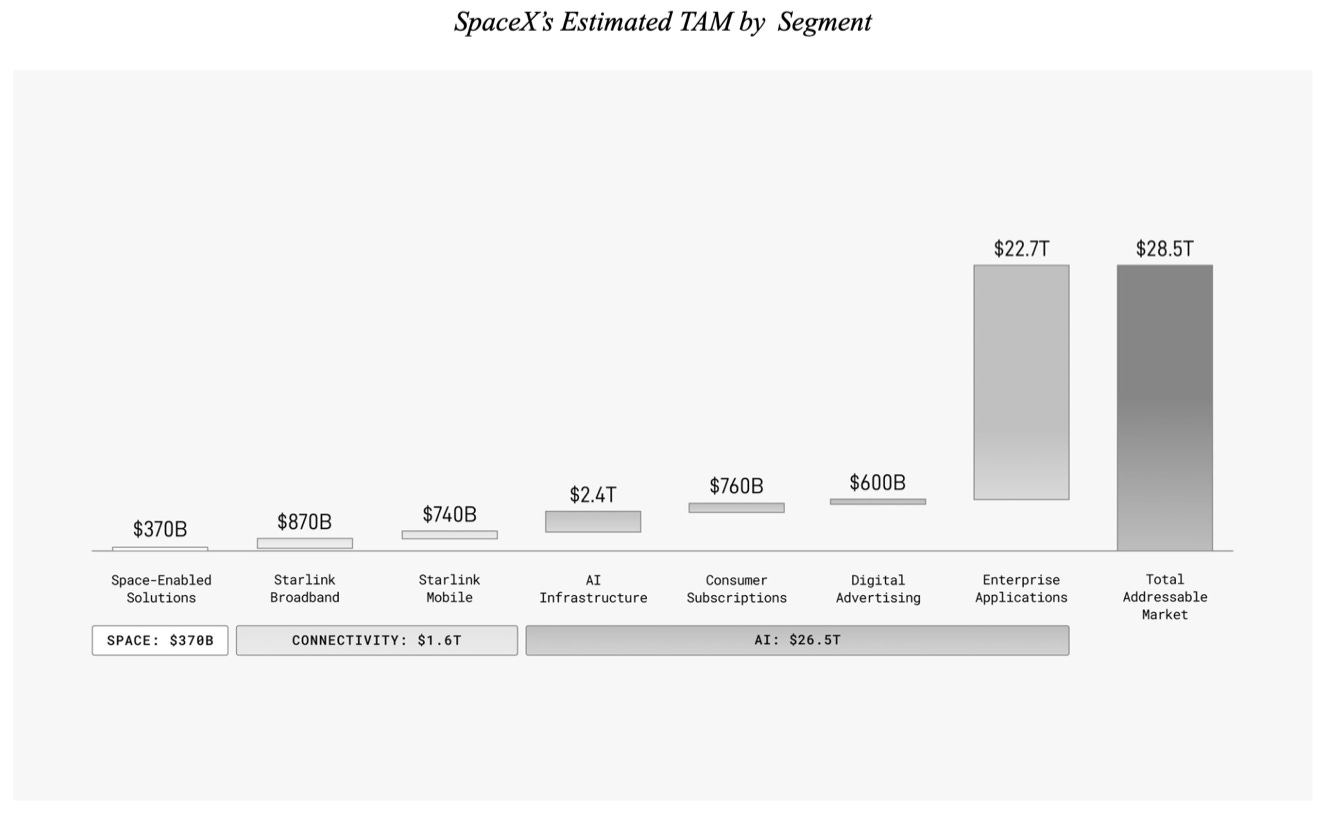
🛰️ The Biggest TAM In History (Maybe)
SpaceX filed its S-1 last month and included a chart that will make every sell-side analyst smile and every skeptic roll their eyes. The company claims a total addressable market of $28.5 trillion. Space and connectivity together: $1.97 trillion. AI: $26.5 trillion.
Yes, they put AI in their TAM. You can debate whether a rocket company belongs in that number. I think the more interesting question is whether space-based data centers are actually possible.
Start with the physical constraints. We tend to picture a data center as a massive warehouse full of servers, chillers, and utility-scale power. That image makes orbital compute sound absurd. But you don’t need to put a warehouse in orbit. SpaceX’s current V2 Mini Direct-to-Cell satellites measure about 7.4 meters by 2.7 meters. An Nvidia NVL72 rack is 2.2 meters by 1.1 meters. We’re already in the right size range. The satellite can carry the rack.
The hard problem is power. A V2 Mini uses about 25kW. An NVL72 needs 135kW, and also has to get rid of that heat. On earth, you run water through chillers. In orbit, you deploy radiator arrays, probably 200+ square meters per rack. That’s not trivial. But it’s an engineering problem, not a physics problem. There’s nothing in the laws of nature that says it can’t be solved.
The use case that makes this work isn’t training and it isn’t the fast inference you need when a human is waiting for a response. It’s agentic inference: AI running overnight jobs, executing multi-step tasks, doing work without a human in the loop. Latency barely matters. Capacity matters enormously. That workload is probably the largest AI market long-term, and it maps well to the physics of orbital compute.
The “stick” is the constraint you might not be thinking about. Terrestrial data center buildout is running into serious community opposition. Zoning fights. Power grid pushback. NIMBY dynamics that globalization never triggered because factories close quietly, but data centers require permits. If enough compute demand materializes and enough communities say no, orbit stops being exotic and starts being the only option with available land.
The risks are real and the assumptions stack up fast. Starship has to work at scale. Chip supply has to remain available and reliable. Demand for compute has to be far larger than it is today. Radiation messes with calculations and every satellite is disposable. A lot has to go right.
But the core question, whether this is physically possible, has a pretty clear answer. It is. Whether SpaceX is the one who pulls it off, and whether the $2 trillion IPO valuation makes sense, are separate questions entirely.
Sources: SpaceX S-1 Filing, SEC EDGAR; Ben Thompson, “The SpaceX IPO and Data Centers in Space”, Stratechery, May 27, 2026
🚙 Interesting Drive-By’s 🚙
🔄 The Math Doesn’t Math - a blunt teardown of the Nvidia-neocloud financing loop, mapped onto 2008. The throughline: when a vendor funds its own demand (Nvidia into CoreWeave, IREN, Nebius, Lambda, Crusoe), reported revenue stops being a clean read on real adoption, and the early-warning signals get suppressed until the correction hits all at once. Gets polemical toward the end, but the circular-financing mechanics are worth the read with the Mag 7 now a third of the S&P.
🏭 Thank God For Data Centers - from Packy McCormick, and a useful counterweight to the piece above. His argument: data centers are the new “Buyer of Capabilities,” the role NASA and the DoD played for the integrated circuit, funding nuclear, geothermal, HVDC grids and other hard tech down the learning curve years early. Even if you think it’s a bubble, he says, the buildout pulls real technology forward. (Paywalls partway in.)
💼 Is AI Going to Destroy Our Lives or Not? - Kyla Scanlon on what AI is actually doing to the labor market. The useful frame: judge a job by its “dimensionality,” the number of distinct tasks it bundles. Low-dimensional roles are exposed; high-dimensional ones threaded with judgment, accountability and taste get more productive. She also lands on the retirement angle, with the AI IPOs (SpaceX included) shaping up as a transfer of risk from insiders to the retail investors and pension funds buying in.
🚗 As Robotaxis Spread, Luxury May Soon Mean Having a Human Driver - a short, sharp companion to the Scanlon piece. As Waymo and Zoox commoditize the driverless ride, the human chauffeur becomes the status symbol, which is why Uber and Lyft are buying up white-glove services even as they add robots. Same Alex Imas insight underneath: when machines make something abundant, the dollars chase whatever still carries a human touch. The kicker: horses didn’t vanish after the car, they became a rich person’s pastime.
🧭 Anti-Aging Points You Backward. Life Design Points You Forward - from Barbara Waxman. The 30 years we’ve added to life expectancy didn’t tack on at the end; they opened up two new stages that need planning, and not just the financial kind. Her sharpest point: beliefs about aging aren’t a soft variable, they’re a biological one.
👋🏼 Parting Thought
The 3rd and final running of the Belmont Stakes in Saratoga Springs concluded this weekend. Now, it’s time for things to get back to normal. 😎

If you have any cool articles or ideas that might be interesting for future Sunday Drive-by’s, please send them along or tweet ‘em (X ‘em?) at me.
Please note that the content in The Sunday Drive is intended for informational purposes only, and is in no way intended to be financial, legal, tax, marital, or even cooking advice. Consult your own professionals as needed. The views expressed in The Sunday Drive are mine alone, and are not necessarily the views of Investment Research Partners.
I hope you have a relaxing weekend and a great week ahead. See you next Sunday...
Your faithful financial provocateur,
-Mike
If you enjoy the Sunday Drive, I’d be honored if you’d share it with others.
If this was forwarded to you, please subscribe and join the other geniuses who are reading this newsletter.