

👋🏼 Hello friends! Let’s enjoy another Sunday Drive around the internet.

🎶 Vibin'
St. Patrick’s Day is right around the corner. To honor my wife’s heritage as well as my good friend, MW, who is an American, but also an Irish citizen, this week I’m vibin’ to The Irish Tenors’ version of When Irish Eyes Are Smiling. ☘️
💭 Quote of the Week
“Many of the most meaningful things in life look inefficient when viewed through the wrong lens. But that doesn’t make them wasteful. It makes them human.“
— Sahil Bloom
📈 Chart of the Week
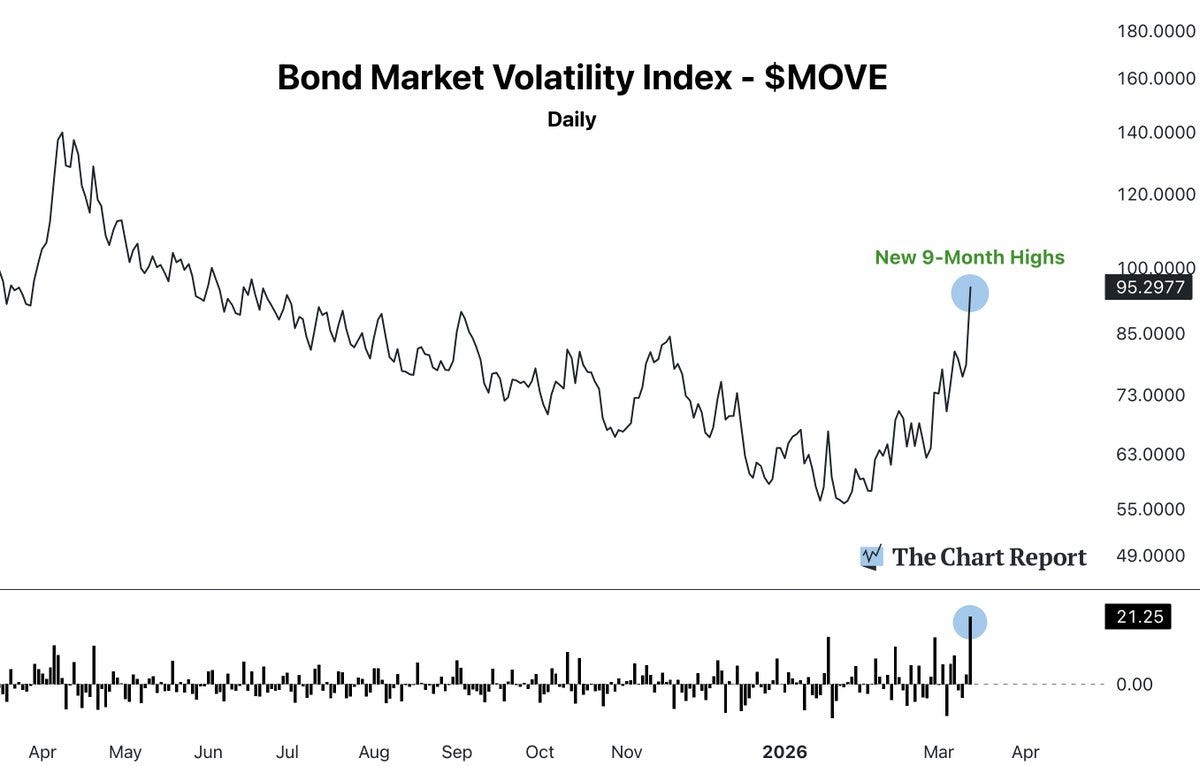
When the Bond Market Gets Nervous
Every once in a while the bond market clears its throat. When it does, equity investors should at least look up from their screens.
This week’s Chart shows the $MOVE Index, often referred to as the bond market’s equivalent of the VIX. It measures implied volatility in U.S. Treasury options, essentially how uncertain investors are about the future path of interest rates. After spending much of mid-2025 in a relatively calm range, the index has surged to roughly 95, marking new nine-month highs.
That’s not a trivial move.
The Treasury market sits at the center of the global financial system. Every discounted cash-flow model, every mortgage rate, every corporate borrowing cost ultimately traces back to the Treasury curve. When volatility in that market rises, it usually means investors are suddenly less confident about where interest rates are headed.
And when the discount rate becomes unstable, risk assets tend to get wobbly.
Historically, spikes in the MOVE Index have often preceded turbulence in risk assets. The logic is straightforward: equity valuations depend heavily on the assumed path of interest rates. When bond traders begin aggressively repricing that path, a stock market narrative built on stable discount rates can unravel quickly.
On the other hand…
Bond volatility does not automatically mean equities are in trouble. In fact, there are plenty of episodes where the MOVE spikes while stocks remain surprisingly resilient. The bond market is often reacting to macro uncertainty that may not immediately translate into weaker corporate earnings.
In other words, the bond market can be nervous without the economy actually breaking.
What did catch my attention in the Chart, however, is the trend. The MOVE didn’t jump from calm to chaos overnight. It bottomed near the mid-50s earlier in the year and has been grinding higher for weeks before this latest breakout. That kind of slow-building rise in volatility suggests a deeper disagreement forming about the future path of policy rates.
In my experience, persistent uncertainty tends to matter more than single-day spikes.
There’s also a structural factor worth considering. Over the past two years the Treasury market has been absorbing an enormous amount of new supply while the Federal Reserve has stepped back as a marginal buyer. That shift alone can create more volatility in rates, even if the underlying economy remains stable.
So what should stock investors do with all this?
Probably not panic.
But it is a reminder that the calm backdrop for interest rates that supported equity valuations through much of 2025 may be fading. When bond volatility rises, the market’s margin for error shrinks, particularly for long-duration assets where valuations depend heavily on future cash flows.
Think mega-cap growth stocks, speculative tech and healthcare, and anything trading on distant earnings expectations.
The bond market hasn’t necessarily sounded an alarm yet.
But it has definitely raised an eyebrow.
And when the largest and deepest market in the world starts getting uneasy, it’s usually worth paying attention.
🚙 Interesting Drive-By's 🚙
🤔 Older Americans Power a Gray-Shaped Economy
🎯 America Built a Workforce That Never Exits
🤷🏼♂️ Something Feels Weird About This Economy
👋🏼 Parting Thought

If you have any cool articles or ideas that might be interesting for future Sunday Drive-by's, please send them along or tweet 'em (X ‘em?) at me.
Please note that the content in The Sunday Drive is intended for informational purposes only, and is in no way intended to be financial, legal, tax, marital, or even cooking advice. Consult your own professionals as needed. The views expressed in The Sunday Drive are mine alone, and are not necessarily the views of Investment Research Partners.
I hope you have a relaxing weekend and a great week ahead. See you next Sunday...
Your faithful financial provocateur,
-Mike
If you enjoy the Sunday Drive, I'd be honored if you'd share it with others.
If this was forwarded to you, please subscribe and join the other geniuses who are reading this newsletter.