

👋🏼 Hello friends! Let’s enjoy another Sunday Drive around the internet.

🎶 Vibin'
There’s certainly a lot of turmoil in the world these days, especially in the Middle East. It’s a confusing time, but I find it helpful to hold to my conviction that, in the end, faith and optimism always carry the day.
So this week, I’m vibin’ to Toto’s classic hit, Hold The Line.
💭 Quote of the Week
“When you pray for rain, you have to deal with the mud, too.“
— Anonymous
📈 Chart of the Week
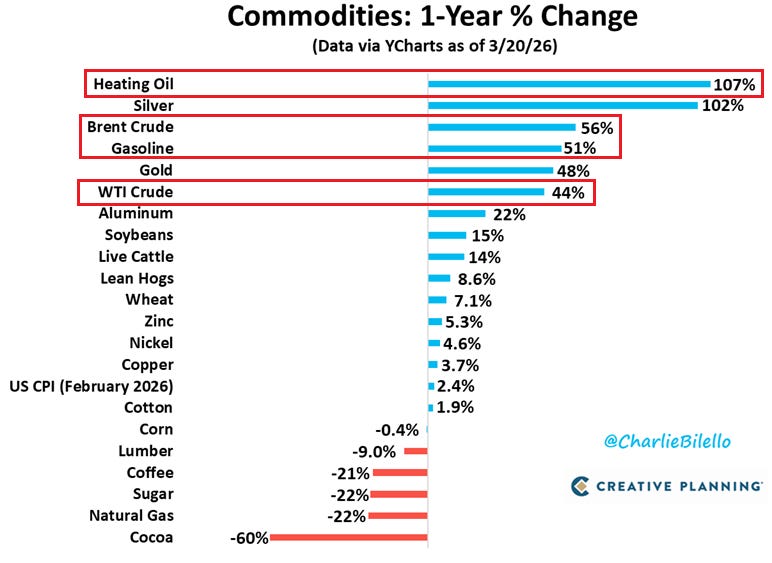
Why Fertilizer Could Be the Real Inflation Story
This week’s Chart tells a familiar story: energy prices are surging. Heating oil up 107%. Brent crude up 56%. WTI crude up 44%. The boxes drawn around those numbers tell you what the market is focused on. But there may be a far more consequential story hiding just below the surface.
The closure of the Strait of Hormuz, now entering its fourth week following U.S.-Israeli strikes on Iran, isn’t just an oil shock. It’s a fertilizer shock. The agricultural reckoning that follows could potentially dwarf the energy price spike in both duration and breadth.
Nearly 50% of global urea exports originate from countries west of the Strait and transit through that critical waterway. Urea is the world’s most widely used solid fertilizer, the input that makes large-scale corn, wheat, and soybean production economically viable. Prices for urea have already surged more than 30% since the war began, and at least 21 ships carrying nearly a million metric tons of fertilizer cargo are physically stranded in the Gulf.
The timing couldn’t be worse. This disruption falls in the middle of spring planting season, which generally runs from mid-February to early May in the Northern Hemisphere. Even if the Strait reopens soon, restarting production and transport for fertilizers could take weeks, weeks that Northern Hemisphere farmers simply do not have.
What does this mean for grocery bills? More than many realize. Higher fertilizer costs squeeze grain yields, and grain is the feedstock for virtually all livestock. Cattle, hog, and poultry producers are all downstream consumers of corn and soybeans. The Chart shows live cattle up 14% and lean hogs up 8.6% over the past year, and those figures predate the full fertilizer crunch working its way through the supply chain. Chicken, not shown in the chart, faces similar pressure.
Oxford Economics has already raised its Q2 2026 fertilizer price forecast by roughly 20%, with risks “skewed to the upside.” Energy costs represent approximately half the total retail food bill, meaning the inflationary impulse from this shock is broad-based and persistent, not a one-month blip in the CPI.
The energy commodities in the Chart are attention-grabbing. But I’m watching the agricultural commodities. The second-order effects of a fertilizer shortage are slower, stickier, and harder to reverse. I believe that’s the inflation story for the next 12-18 months, and I don’t think that it’s been fully priced in yet.
Sources: Center for Strategic & International Studies, The Fertilizer Institute
🚙 Interesting Drive-By's 🚙
💰 Want to Open a Trump Account (and Get $1,000) for Your Child?
🤔 Artificial Intelligence Faces a Fertility Test
🤷🏼♂️ What the Heck Is a Zero-Employee Business?
👋🏼 Parting Thought
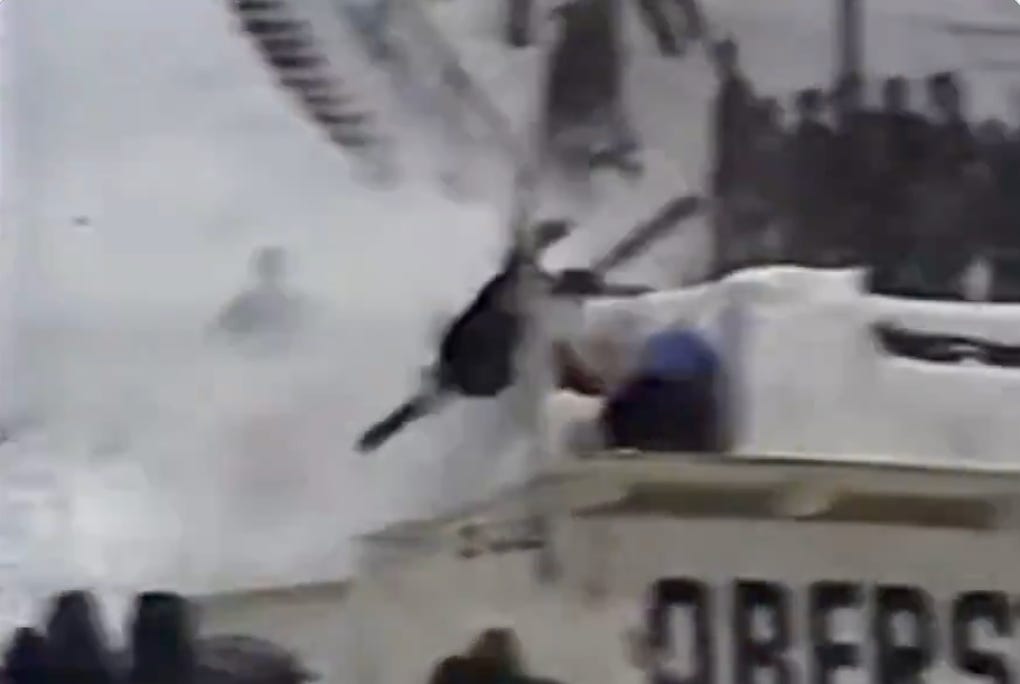
Yesterday was “Agony of Defeat Guy” Day.
56 years ago, on March 21, 1970, a 22-year old Slovenian ski jumper Vinko Bogataj took the iconic spill at the World Ski Jumping Championships in West Germany and it was forever memorialized in the intro to ABC’s Wild World of Sports.

If you have any cool articles or ideas that might be interesting for future Sunday Drive-by's, please send them along or tweet 'em (X ‘em?) at me.
Please note that the content in The Sunday Drive is intended for informational purposes only, and is in no way intended to be financial, legal, tax, marital, or even cooking advice. Consult your own professionals as needed. The views expressed in The Sunday Drive are mine alone, and are not necessarily the views of Investment Research Partners.
I hope you have a relaxing weekend and a great week ahead. See you next Sunday...
Your faithful financial provocateur,
-Mike
If you enjoy the Sunday Drive, I'd be honored if you'd share it with others.
If this was forwarded to you, please subscribe and join the other geniuses who are reading this newsletter.